
لوجستيات أخرى

Nigerian logistics mogul Taiwo Afolabi warns eastern ports crisis will choke the entire economy


Taiwo Afolabi, the shipping magnate who built SIFAX Group from a single freight forwarding desk into one of Nigeria's most powerful logistics conglomerates, is calling out the federal government for what he describes as a systematic abandonment of the country's eastern ports — and warning that the consequences are now showing up in real time at Tin Can Island Port in Lagos.
Afolabi made the remarks while receiving Dr. Akutah Pius Ukeyima, executive secretary and chief executive of the Nigerian Shippers Council, at SIFAX Group's Lagos headquarters this week. The visit was a significant one: Afolabi is not simply a critic of Nigeria's port infrastructure. He is among its most invested stakeholders, with SIFAX holding the concession to operate Terminal C at Tin Can Island Port, a position the group has held since 2006 when it became the first wholly Nigerian-owned company to run a major port terminal.
"My passionate appeal to the government is to extend the port modernisation initiative to the eastern ports," Afolabi said. "As you can see, economic activities at the ports are on the increase year on year."
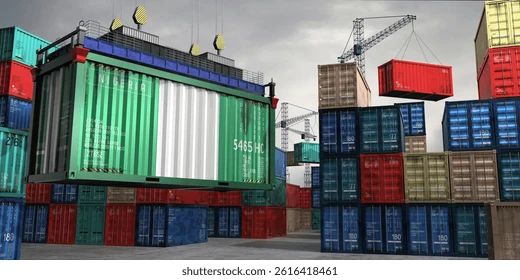
The congestion problem at Tin Can Island has reached a level that industry operators say is no longer manageable within the existing infrastructure. The corridor was not designed to handle the volumes it now processes, and the pressure has been building for years as cargo that would otherwise move through Warri, Onne and Calabar continues to funnel into Lagos instead. MSC containers have been reported littering the terminal, customs agents have raised alarms publicly, and the gridlock along the Tin Can axis has become, in Afolabi's words, "a recurring cost for businesses, a source of frustration for transporters, and a drag on the economy."
The fix, as Afolabi sees it, is not complicated. It requires political will and a dredging budget.
"This is the time for the government to resuscitate those ports in the eastern part of Nigeria," he said. "The government needs to dredge the Warri, Onne and Calabar ports so that large vessels can berth there safely and reduce the pressure on the Lagos ports."
Each of those three ports serves a distinct economic geography. Warri sits at the center of the Niger Delta oil belt and has historically served the petroleum and petrochemicals sector. Onne, in Rivers State, is Nigeria's largest oil and gas free zone and handles bulk cargo for the upstream energy industry. Calabar serves the deep southeast and has been proposed repeatedly as a gateway for cross-border trade with Cameroon. All three have suffered from decades of inadequate dredging, poor road connections and inconsistent federal investment, leaving them significantly underutilized while Lagos strains under demand.
Afolabi knows this landscape as well as anyone in Nigeria. He founded SIFAX in 1988 at the age of 26 with a small team and a freight forwarding operation at Apapa Port. Over the following three decades, he built it into a multinational with interests across maritime, aviation, haulage, oil and gas, financial services and hospitality. The group operates with offices in Ghana, South Africa, the United States, Belgium and the United Kingdom, and is exploring new markets in Djibouti and Equatorial Guinea.
His stake in Skyway Aviation Handling Company, known as SAHCO, gives him one of his most visible listed holdings. The company has staged a sharp financial turnaround under SIFAX's stewardship. In the first half of 2025, SAHCO's revenue rose 74 percent to 21.06 billion naira ($1.3 million at current rates), while profit surged 155 percent. The stock, valued at approximately $48 million, had risen more than $30 million since the start of 2025 alone.
The SIFAX port business is separate but structurally linked to the same national infrastructure challenges Afolabi is now flagging publicly. The more congested Tin Can Island becomes, the more pressure falls on operators like SIFAX to absorb inefficiencies that should be solved at the policy level, not the terminal level.
Ukeyima, for his part, acknowledged the group's contribution. He described SIFAX as one of Nigeria's leading maritime investors and praised Afolabi for taking advantage of the full maritime value chain to drive economic growth. He committed to collaboration between his agency and the company.
That commitment will mean little if the eastern ports question goes unanswered. Nigeria has been promising to develop its port infrastructure outside Lagos for the better part of two decades. Successive administrations have commissioned studies, launched consultations and announced plans. The Warri, Onne and Calabar ports remain underserved.
Afolabi's intervention this week adds the weight of Nigeria's most consequential private maritime operator to a case the government has heard before. Whether that changes the calculus in Abuja is another matter.
مقالات ذات صلة

Transport and logistics to the fore in 2026!...
04 مارس, 2026 08:39
Trade flows shift as Middle East risks intensify...
04 مارس, 2026 11:37
Emirates, Etihad Airways suspend flights as region...
05 مارس, 2026 07:45
Shipping charges hike will worsen economic hardshi...
06 مارس, 2026 08:58
DHL continues to accept Middle East orders, but wa...
06 مارس, 2026 09:02
TIACA confirms Glyn Hughes will step down as Direc...
06 مارس, 2026 09:51
Qatar activates Saudi land transit route to mainta...
09 مارس, 2026 08:42
Kenya Airways begins airlift for WRC Safari Rally ...
10 مارس, 2026 13:01
GLS Group and APM Terminals partner to launch Libe...
11 مارس, 2026 08:20