Rail

HSBC Leads €1bn Angola Railway Financing Deal



Structured ECA-backed deal deepens Benguela Railway build-out
Under Presidential Dispatch No. 269/26, dated 5 August, President João Lourenço authorised the Ministry of Finance to sign a financing agreement with HSBC Bank Plc for the Luena–Saurimo rail section. HSBC will act as arranger, coordinator and agent for a syndicate of creditor institutions providing over €1bn in funding. The agreement covers the construction of a 260km railway link between Luena, in Moxico province, and Saurimo, in Lunda Sul, extending the Benguela Railway eastwards.
The core of the structure is three export credit agency-backed credit lines with a combined disclosed capacity of €665m. According to the presidential dispatch, the package includes up to €250m backed by UK Export Finance, up to €290m backed by Poland’s KUKE and up to €125m backed by Dutch ECA Atradius. These tranches sit within a broader package that state media and regional outlets report as exceeding €1bn.
A related financing agreement with HSBC, acting again as arranger for the creditor syndicate, has also been authorised to fund the state’s upfront contribution. Executive media in Portugal and Angola report that this second facility totals about US$162.2m, equivalent to €142.2m at prevailing conversion assumptions, and will finance the 15% down payment on the Luena–Saurimo construction contract. The structure mirrors other recent Angolan sovereign financings, in which the state covers an initial equity-style tranche while ECAs and commercial lenders provide the bulk of long-tenor debt.
For the Ministry of Finance, the presidential dispatch provides formal authority to contract the loans and represent the Republic of Angola in negotiations. The measure aligns with the government’s wider public investment programme, which has leaned on syndicated bank loans and ECA cover to fund strategic infrastructure since 2025. One senior infrastructure analyst in Luanda notes that this kind of Angola railway financing shows how European ECAs now anchor risk in projects once funded almost entirely by bilateral creditors.
What does the deal mean for investors?
The Luena–Saurimo line is designed to enhance freight and passenger connectivity across eastern Angola and to feed volumes into the Lobito Corridor. According to the presidential dispatch and local reporting, the strategic goal is to link the east of the country more effectively to the Port of Lobito and to support the transport of copper, cobalt and manganese from neighbouring Democratic Republic of Congo and Zambia. This aligns with US and European efforts to channel billions of dollars into the corridor as a critical minerals route.
Recent financing rounds for the Lobito Atlantic Railway and associated upgrades already include a US International Development Finance Corporation loan and a joint DFC–Development Bank of Southern Africa package exceeding US$750m. The Luena–Saurimo project plugs into that pipeline by extending domestic Angolan track to better capture regional traffic flows. As a result, the HSBC-led transaction positions Angola to leverage both sovereign borrowing and concessional development finance around a single corridor.
For European ECAs, the transaction indicates growing comfort with Angola’s credit and project-execution track record. The split between UK, Polish and Dutch cover also reflects a drive to support national exporters into Angola’s rail, signalling and rolling stock markets. Meanwhile, the combination of ECA guarantees and a syndicate of commercial lenders lowers funding costs relative to purely market-priced debt, while spreading exposure across multiple jurisdictions.
Investors will watch several elements closely. Construction progress and cost control on the 260km line will be key to maintaining lender confidence and avoiding renegotiations. Coordination with the existing concession for the Lobito Atlantic Railway and with development finance institution funding for corridor upgrades will also shape throughput and revenue potential. For fixed-income investors, the deal adds another data point on Angola’s willingness to prioritise infrastructure spending within its external debt strategy.
The broader signal is that Angola is using structured Angola railway financing to lock in long-term growth options along the Lobito–Benguela axis rather than relying solely on hydrocarbons. If execution holds, the Luena–Saurimo project could reshape trade flows across eastern Angola, and investors will track how quickly the new line translates into higher corridor volumes and additional ECA-backed deals.
Related Articles
South Africa's Transnet to invest $7 billion in ra...
22 Oct, 2025 08:17
AD Ports unit to run UAE-Oman freight rail service...
27 Oct, 2025 08:54
Morocco’s Transport Minister Promises Railway Netw...
29 Oct, 2025 11:22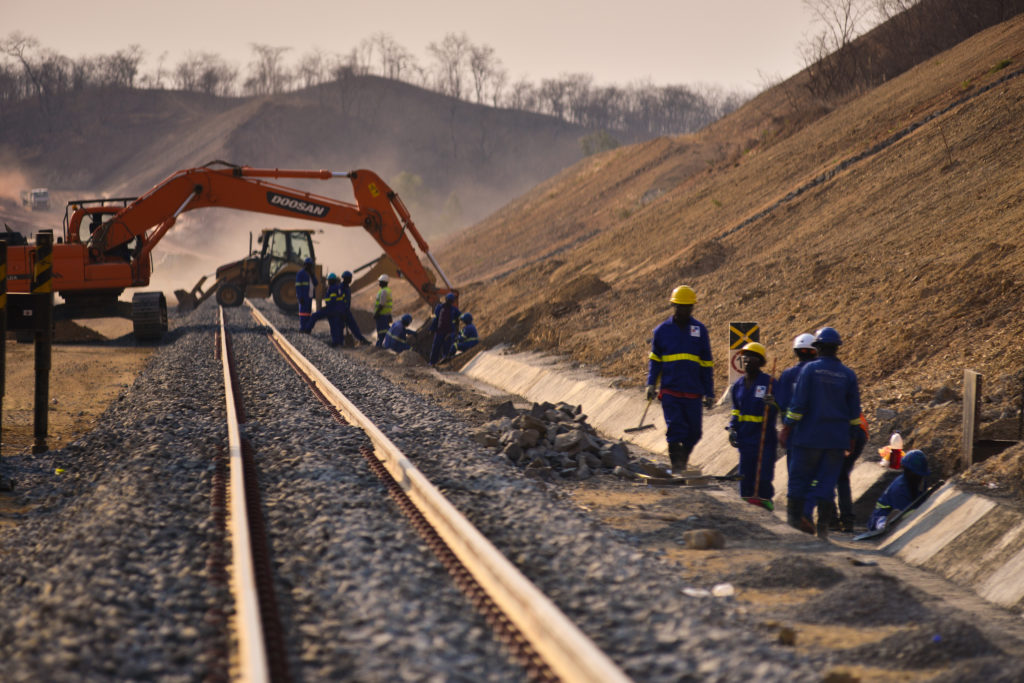
Angola seeks $4.5 billion for rail link to Zambia’...
31 Oct, 2025 08:03
How digital tools are powering the Middle East’s r...
06 Nov, 2025 09:14
Jordan, Syria and Turkey move ahead with plans to ...
10 Nov, 2025 10:14
Siemens unveils Velaro High-Speed train at TransME...
10 Nov, 2025 12:10
Why partner with UD Trucks South Africa for the Ni...
12 Nov, 2025 09:07
Hitachi Rail to modernise Egypt’s oldest tramway i...
13 Nov, 2025 11:00