Energy Other

Why Ethiopia’s Gas-to-Fertilizer Bet Matters for East Africa


By: FDRE institute of forreign affairs
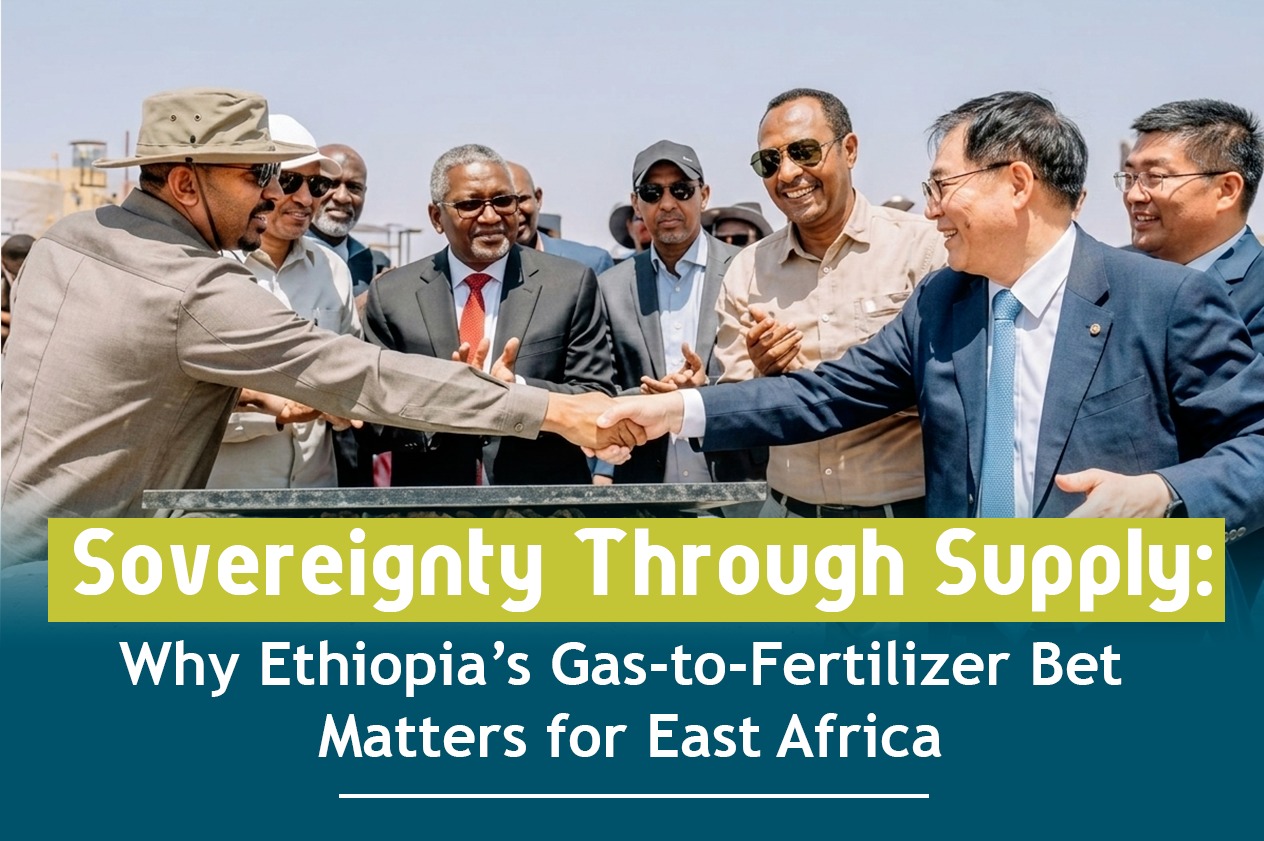
The March 2026 agreement between Dangote Industries Limited (DIL) and China’s GCL Group—a $4.2 billion, 25-year deal signed in Lagos—invites a reading far deeper than that of a conventional investment. By securing a long-term gas supply from the Calub field for a 3-million-tonne-per-year urea plant in Gode, Somali Region, the project transcends a mere industrial partnership. Beneath its commercial framing lies a more consequential strategic recalibration: a deliberate attempt to convert Ethiopia’s structural vulnerability into productive leverage, signaling a decisive shift from resource dependency toward supply-driven sovereignty.
For decades, Ethiopia’s agricultural backbone has remained tethered to volatile global fertilizer markets. This dependence has exposed the country to recurrent foreign-exchange pressures, supply disruptions, and inflationary spillovers. Fertilizer imports, essential for sustaining yields in a predominantly agrarian economy, have consistently drained hard currency reserves while leaving domestic production exposed to exogenous shocks—from global price spikes to logistical bottlenecks.
This age-old pattern seems to be on the brink of concluding following the decisive Calub–Gode initiative. While exporting natural gas as a raw commodity has historically yielded limited domestic value, Ethiopia is now channeling it into downstream industrial use. Under the agreement, gas sourced from the Calub Gas Field in the Ogaden Basin will be transported via a dedicated 108-kilometre pipeline to feed a 3 million tonne-per-year urea fertilizer plant in Gode. This facility, estimated at $2.5 billion and structured as a 60:40 joint venture between Dangote Group and Ethiopian Investment Holdings (EIH), is expected to become operational by 2029.
In fact, the Gode project should be viewed through a transformative lens. Natural gas from Calub is not simply being extracted for export earnings or rent generation; it is being channeled into an input that can strengthen Ethiopia’s food system and reduce its vulnerability to external supply shocks. This represents a more strategic use of natural resources than the classic extractive model by tying energy to domestic productive needs. Consequently, this approach retains more value within the economy while granting the Ethiopian state and market greater control over sectors that directly affect inflation, agricultural output, and foreign-exchange demand.
In this sense, sovereignty is not being asserted through rhetoric. It is being built through supply. A country becomes more sovereign when it can secure essentials with less dependence on volatile external markets. Fertilizer is one of those essentials. Ethiopia’s bet is that the path to greater autonomy runs through productive capacity at home.
The Geography of Strategic Confidence
Perhaps most revealing is the project’s spatial dimension. By anchoring this industrial complex in Ethiopia’s Somali Region, the initiative challenges long-standing assumptions about the economic geography of the Ethiopian state. Historically framed through narratives of peripherality and fragility, the Gode-Calub corridor introduces a more constructive paradigm: transforming the region from a peripheral zone into one of opportunity, connectivity, and significant economic contribution.
The implications are both economic and political. Large-scale investments of this nature tend to generate spillover effects, ranging from transport corridors and service industries to workforce development and ancillary infrastructure. Analysts anticipate that the Gode fertilizer complex will catalyze thousands of direct and indirect employment opportunities while stimulating broader regional development.
Yet the significance extends beyond economics. In a federal system where questions of inclusion and equitable development remain politically salient, embedding high-value industrial projects in historically marginalized regions serves as a mechanism of state consolidation. It reframes the periphery not as a site of governance challenges but as a contributor to national growth and regional integration.
Equally consequential is the outward orientation this creates. Positioned in eastern Ethiopia, the Gode corridor is geographically proximate to key regional markets, including Somalia and Kenya. This locational advantage enhances Ethiopia’s ability to project economic influence across the Horn of Africa, transforming internal development into a platform for regional engagement.
Fertilizer as a Foundation of National Strength
The Gode fertilizer plant transcends from being a mere an industrial asset. It is also a macroeconomic instrument. Its strategic value can be understood across three interlocking dimensions.
First, agricultural productivity. Ethiopia’s economy remains deeply rooted in agriculture, with millions of livelihoods dependent on consistent yields. Reliable domestic fertilizer production can significantly enhance productivity, mitigate the effects of climate variability, and strengthen food security. In this sense, the project addresses not only economic but also social stability concerns.
Second, foreign-exchange relief. Ethiopia’s chronic hard-currency shortages have constrained its ability to finance imports and stabilize its balance of payments. By substituting imported fertilizer with domestically produced supply, the country stands to reduce a major source of foreign-exchange outflow. Over time, this could ease macroeconomic pressures and create fiscal space for other strategic priorities.
Third, market repositioning. Once operational, the Gode facility is expected to fully meet Ethiopia’s domestic urea demand while generating surplus capacity for export. This transition—from net importer to potential regional supplier—alters Ethiopia’s position within East Africa’s agricultural value chains. It enables the country to capture greater value while contributing to regional supply stability.
Fertilizer demand is structurally embedded in the region’s development trajectory. As East African economies seek to modernize agriculture and improve yields, access to affordable and reliable inputs will remain a critical constraint. Ethiopia’s entry into this space as a producer, rather than merely a consumer, carries long-term strategic implications.
An Instrument for East African Integration
The most compelling long-term dimension of the project lies in its regional implications. East Africa’s agricultural potential is widely acknowledged, yet it remains constrained by fragmented markets, underdeveloped infrastructure, and heavy reliance on imported inputs. The Gode fertilizer complex has the potential to address one of these constraints directly.
By supplying fertilizer to neighboring markets; such as, Somalia, Kenya, South Sudan, and beyond, Ethiopia could help shorten supply chains and reduce the region’s exposure to global market volatility. This would not only enhance agricultural productivity in the region but also foster deeper economic interdependence and enhance regional integration.
For Ethiopia, this prospect holds clear strategic value. Regional integration is most effective when built on complementarity, where sectors such as energy, manufacturing, logistics, and agriculture reinforce one another across borders. Fertilizer exemplifies this dynamic particularly well, as it links upstream resource extraction with downstream agricultural demand across multiple economies—functioning not only as a product, but as a platform for broader economic coordination.
In practical terms, this reflects a model of functional regional integration driven less by formal agreements and more by interconnected production networks that generate mutual economic value. In this context, fertilizer serves as both a commodity and a connector, linking industries, markets, and livelihoods across the region.
This aligns with broader continental objectives. Africa’s long-term development strategy increasingly emphasizes the need to build intra-African value chains and reduce dependence on external suppliers. The Calub–Gode–Dangote project contributes to this agenda by demonstrating how local resources can be leveraged to meet regional needs.
Moreover, the involvement of China’s GCL Group introduces an additional layer of geopolitical significance. As part of broader China–Africa industrial cooperation—often associated with the Belt and Road Initiative—the project exemplifies a model of partnership that integrates energy development with industrial production. While such collaborations raise questions about dependency and influence, they also provide access to capital, technology, and expertise that can accelerate structural transformation.
Challenges and Opportunity
It would be reductive, however, to interpret this project as a panacea. Ethiopia continues to deal with a complex array of challenges spanning rom foreign-exchange scarcity, and inflationary pressures, to infrastructure gaps, and regional security dynamics. These constraints shape both the urgency and the difficulty of implementing large-scale industrial projects.
Ironically, these constraints underscore the significance of theGode fertilizer initiative. When vulnerabilities and the aforementioned challenges converge, countries like Ethiopia respond through strategic investments. In Ethiopia’s case, the pursuit of self-sufficiency in fertilizer production reflects a broader effort to insulate the economy from external shocks.
The logic is incremental rather than transformative. Domestic fertilizer production will not resolve all macroeconomic imbalances, nor will it eliminate exposure to global markets. However, it reduces one critical channel of vulnerability. In doing so, it enhances the state’s capacity to manage uncertainty and pursue longer-term development objectives.
Politically, this matters as well. Developmental legitimacy is often tied to the ability of governments to deliver tangible improvements in livelihoods and economic stability. A project that promises enhanced agricultural productivity, job creation, and regional export potential can contribute to this legitimacy—provided it is implemented effectively.
The Measure of Success
The success of the Calub–Gode project will ultimately depend on implementation, but its promise is already evident. It offers Ethiopia a route toward greater strategic autonomy by anchoring a critical national need in domestic production, providing economic substance to sovereignty by reducing reliance on imported fertilizer. Furthermore, it creates a platform for growth by connecting energy resources to agricultural productivity and offers a tangible opportunity for East African integration by positioning Ethiopia as a regional supplier of critical inputs.
For that reason, this investment deserves to be understood in its fullest significance; it is not merely a gas agreement, but a confidence-building milestone in Ethiopia’s effort to overcome structural economic constraints through productive capacity. It serves as a reminder that future autonomy will depend less on rhetoric than on the ability of states to secure control over the systems that feed, power, and connect their economies.
In this respect, Ethiopia’s fertilizer strategy carries a wider lesson: strategic autonomy is rarely built in dramatic moments. More often, it is forged through the steady creation of domestic capabilities in foundational sectors. If Ethiopia delivers on this project, the gains will transcend a single plant or region, extending into food security, macroeconomic resilience, and a more integrated East African future.
Related Articles
Kuwaiti oilfield comes onstream officially after 1...
22 Sep, 2025 12:56
African Energy Week (AEW) 2025: Unlocking the Pote...
22 Sep, 2025 13:22
South Africa warns illegal car imports threaten ne...
23 Sep, 2025 06:31
South Africa Confronts EU Carbon Border Mechanism...
23 Sep, 2025 12:33
South Africa, China Deepen Investment Ties in Key ...
24 Sep, 2025 07:35
Raysut Cement’s Expansion into Libya and North Afr...
24 Sep, 2025 07:40
Nextchem opens regional office in Abu Dhabi...
24 Sep, 2025 08:10
Ghanaian students win top honours in IAEA’s Female...
24 Sep, 2025 09:32
Key Sectors Linking Mauritania and Gambia...
24 Sep, 2025 09:40