المعادن الثمينة

Diamond Drilling Reveals 126-Meter Niobium Interval at Malawi’s Lake Chilwa


Diamond drilling at mining firm Chile’s Minerals’ Mpyupyu project in Malawi has returned niobium mineralization, with hole MPYDD006 intersecting 0.31% Nb₂O₅ over 126 m from 125 m downhole. Mineralization occurs within alkaline quartz-syenite, and the deposit extends deeper than current drilling. It also contains tantalum, gallium and rare earth elements. Results from four more holes are expected this quarter and additional drilling will map how far the mineralization spreads both sideways and down.
Currently, Malawi’s mining sector contributes only to 1% of GDP. However, exploration data show the country hosts a wide range of commercially attractive commodities including uranium, heavy mineral sands, rare earths, graphite and now niobium – many of which are essential to clean energy and industrial supply chains. Niobium’s evolving demand profile, tied to high‑strength alloys and future energy applications, could recalibrate Malawi’s mining trajectory.
Lake Chilwa Emerges as Multi-Commodity Critical Minerals System
The recent discovery adds a new critical mineral dimension to Chilwa’s Lake Chilwa portfolio, which already includes rare earth oxides (TREO) and heavy mineral sands. TREO grades previously identified at the Mpyupyu target, such as 1,661–2,438 ppm over broad intervals, highlight a multi‑commodity system. According to Cadell Buss, Managing Director of Chilwa Minerals, “This discovery is another significant milestone in the evolution of the company and validates that the company’s tenements are on a ‘mineralized system’ hosting multiple critical minerals.”
The close association of niobium with other critical minerals at Lake Chilwa mirrors the multi-commodity nature of globally recognized deposits such as Panda Hill in Tanzania and Araxá in Brazil, where clustered mineralization supports more integrated and scalable project development. This creates potential synergies across infrastructure, logistics and future processing. Niobium itself adds a new layer of value to the project, given its role in high-strength low-alloy steels used in construction, pipelines and automotive manufacturing, as well as in superconducting magnets and emerging battery technologies.
Could Malawi’s Critical Mineral Pipeline Unlock an Economic Boom?
Malawi’s geological potential extends well beyond Mpyupyu. The country already hosts a pipeline of advanced critical minerals projects spanning rare earths, rutile, graphite and uranium. At Kangankunde, mining company Lindian Resources is pushing a rare earth project toward production. In March 2026, the company strengthened its downstream strategy by acquiring a 51% stake in a rare earths processing plant in Kazakhstan for $15 million, giving it a built facility to process feedstock from Malawi rather than relying solely on third-party tolling. Lindian expects both Kangankunde to be in production before the end of 2026, with planned feedstock supply of about 12,500 tons per year of monazite concentrate.
Meanwhile, mining company Sovereign Metals is advancing the definitive feasibility study for its Kasiya rutile project, while also progressing graphite offtake discussions through an MoU signed with Traxys, highlighting the recovery of monazite containing dysprosium, terbium and yttrium as a potential additional rare earth by-product stream. On the uranium side, Lotus Resources’ Kayelekera mine is back into production, with its processing plant operating at 80% capacity in late February, with steady-state production targeted in H2, 2026.
If key projects move to production, Malawi’s mining pipeline could generate $30 billion in cumulative exports between 2026 and 2040, with annual exports reaching $3 billion by 2034. With niobium now joining uranium, rare earths, graphite and rutile in the mix, Malawi is steadily building the foundations of a more diversified and globally relevant mining sector.
مقالات ذات صلة
China’s ‘encouraging’ hydrogen progress witnessed ...
03 مارس, 2026 07:55
Lucara posts lower 2025 revenue, says additional f...
04 مارس, 2026 07:48
Gold bulls say broader rally is intact despite inv...
04 مارس, 2026 08:00
WorldVest Launches Gold Finance Africa, Building a...
04 مارس, 2026 10:44
Gold and silver rallies likely on pause despite ne...
04 مارس, 2026 11:49
Gold prices climb over 1 percent to $5,164 as Midd...
04 مارس, 2026 11:59
‘Extremely robust’ platinum investment demand expe...
04 مارس, 2026 13:08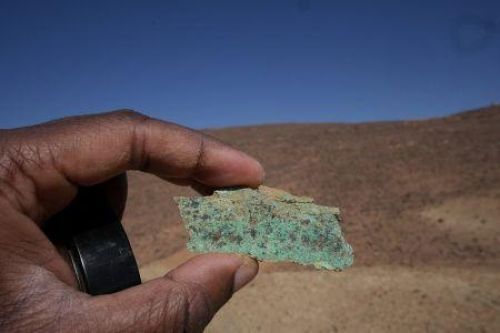
Trigon Metals Launches Silver Exploration Drive in...
05 مارس, 2026 08:00
The Ekapa Mine liquidation – A tragedy compounded...
05 مارس, 2026 08:05