المعادن الثمينة

“West Africa remains one of the world’s most prospective gold-producing regions”, Ian Cockerill, CEO of Endeavour Mining


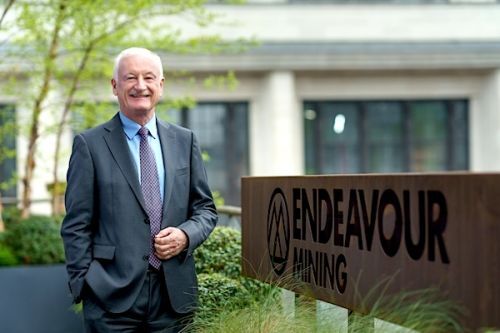
Ecofin Agency : Endeavour reported record financial results in the first quarter 2026, against a backdrop of high gold prices and despite a slight decrease in production. How do you see the link between your operational performance and this financial performance, and what does it say about the strength of your business model?
Ian Cockerill : Q1 was a strong quarter operationally and a record quarter financially, thanks to stable production and costs in this high gold price environment. Importantly, all of our mines performed in line with, or slightly better than expectations, as we produced 282,000 ounces, which is approximately 26% of the low-end of our full-year guidance range. This positions us well to achieve our full-year guidance, with production expected to progressively improve through the second half of the year.
On costs, our royalty adjusted all-in sustaining cost came in towards the lower end of the guidance range giving us a good platform for the full year. That operational delivery and cost discipline meant we were able to convert the stronger gold price into record free cash flow.
This consistent operational performance is underpinned by our high-quality portfolio, comprised of large, long-life mines that are relatively high-grade and low-cost. Our business model is based on our ability to sustainably deliver exploration success, replace production depletion and discover new projects to ensure our operating portfolio remains resilient and our organic growth pipeline remains full.
Ecofin Agency : Endeavour says it contributed USD 2.8 billion to its host countries in 2025, up 27%. What does this figure cover in concrete terms, and how is it split between taxes, royalties, local procurement and employment?
Ian Cockerill : More than 72% of our revenues were reinvested directly into host country economies in 2025, and that figure breaks down across three pillars.
The largest is local economic integration: $1.6 billion in procurement, directed to suppliers 86% of whom are based in our host countries, alongside a 95% national workforce and $309 million paid in salaries and benefits. The second is our direct contribution to public revenues, with $919 million paid to host governments through taxes, royalties and dividends. The third is our support to national financial systems, with $69 million repaid to local financial institutions.
Every dollar spent on local procurement, every job filled by a national employee, every loan repaid to a domestic bank strengthens supply chains, deepens financial markets and builds lasting institutional capacity.
Ecofin Agency : Across several gold-producing countries in West Africa, governments are seeking to capture a greater share of value locally. How do you view this evolution in expectations, and how is Endeavour responding in its relationships with host countries?
Ian Cockerill : The fiscal frameworks in West Africa are relatively consistent across each country that we operate in, where the benefits of membership in the West African Economic and Monetary Union help ensure alignment. Typically, these frameworks are updated on a 10-year cycle, with the natural evolution being slightly higher government take over time, particularly in this higher gold price environment. As a business, we welcome stability and consistency in government fiscal policy as a prerequisite for sustained investment, while recognising the ever-increasing demands on government treasuries, not just in West Africa, but globally.
“Over the past five years, our Group has contributed more than $12 billion to the economies of its host countries, nearly seven times the amount returned to stakeholders over the same period.”
So it is a global trend, and one we engage with constructively with our host countries. What makes this work is mutual trust. Governments honouring existing agreements and ensuring that any changes are sustainable for both states and operators. Endeavour delivering on its commitments, and our contribution is meaningful.
Over the past five years, our Group has contributed more than $12 billion to the economies of its host countries, nearly seven times the amount returned to stakeholders over the same period, reinforcing our position as one of the largest private-sector contributors to public revenues in West Africa.
We are focused on engaging with government at every level, in an open and transparent way, so that we are involved in any such discussions, to ensure that both our host nation governments and all our other stakeholders, can continue to share in the benefits of our strong operational performance and the higher gold price environment.
Ecofin Agency : Assafo-Dibibango is expected to become one of your key growth drivers. Beyond this project, where do you see the next major gold opportunities in Africa that could sustainably transform your production profile?
Ian Cockerill : Assafo-Dibibango is expected to add 320,000 ounces a year for its first eight years, at first-quartile all-in sustaining costs. It is a tier-one asset, and importantly, one we discovered organically.
Beyond Assafo-Dibibango, we have several assets with significant resource upside. At Sabodala-Massawa we are developing an underground expansion, at Houndé we have made a promising discovery near the main pit, and at Ity we have several exciting near-mine prospects. This brownfield upside underpins ongoing production growth across our existing portfolio, while our exploration programme supports longer-term growth.
“At Houndé we have made a promising discovery near the main pit, and at Ity we have several exciting near-mine prospects.”
In December last year, we announced our five-year exploration strategy, targeting 12 to 15 million ounces of new resources over the 2026 to 2030 period, at a discovery cost of less than $40 per ounce. The goal is not only to replace production depletion over that period, but to add two to three new greenfield deposits into our pipeline, supporting continued organic growth beyond 2030.
Ecofin Agency : The gold sector is undergoing a new wave of consolidation. What opportunities and risks does this reshaping of the industry create for Endeavour, and what criteria would need to be met for you to consider a major transaction, given your long-standing focus on organic growth?
Ian Cockerill : The current consolidation trend reflects the industry's focus on securing high-quality, long-life assets and sustainable growth.
Historically, Endeavour has been incredibly successful with organic growth, created via the exploration drill bit, and we see no reason to back away from that strategy. From our established operating platform in Côte d'Ivoire, Senegal and Burkina Faso, with Assafo-Dibibango and our exploration programme, we have a clear pathway to grow production to 1.5 million ounces by 2030.
“Endeavour has been incredibly successful with organic growth, created via the exploration drill bit, and we see no reason to back away from that strategy (…) We do not need M&A to achieve this objective.”
We do not need M&A to achieve this objective. That said, we continually assess opportunities to enhance our portfolio where they are strategically compelling, create value for shareholders, and allow us to apply Endeavour’s exploration, project development and operating expertise to improve the asset. Any transaction would be evaluated against our disciplined criteria around strategic fit, risk profile, financial returns and overall value creation.
We will also continue to use joint ventures selectively, as we are with East Star Resources in Kazakhstan, to gain low-risk, low-cost access to highly prospective, underexplored gold provinces and build the longer-term organic growth pipeline.
Ecofin Agency : What could the West African gold industry look like by 2030, and what role does Endeavour, already the region’s leading producer, intend to play?
Ian Cockerill : West Africa is already one of the world's most prospective gold-producing regions, and we believe its importance can continue to grow, under mutually favourable fiscal terms, through producers investing in new discoveries, mine developments and infrastructure to unlock the region's significant geological potential.
As the region's leading gold producer, Endeavour intends to remain at the forefront of that growth by responsibly developing our portfolio, advancing our project pipeline, including Assafo-Dibibango, investing in exploration and continuing to deliver meaningful economic value to our host countries and long-term returns for our shareholders.
Ecofin Agency : Less than a year after the agreement aimed at relaunching Kalana, Endeavour is now seeking local partners to take over the project. What has changed in your assessment of this asset, and how do you view the outlook for mining investment in Mali today?
Ian Cockerill : Kalana remains an early-stage development project that is not a core part of Endeavour's portfolio. After exploring different structures, we concluded that a joint venture with a dedicated partner is the optimal path, ensuring the project receives the focused investment it requires while allowing Endeavour to concentrate its own capital on our core assets and growth pipeline.
We have maintained continuous dialogue with the Malian authorities throughout this process, keeping them fully informed, and we are working towards an orderly transition that delivers lasting value for all stakeholders.
Interview by Louis-Nino Kansoun
مقالات ذات صلة
China’s ‘encouraging’ hydrogen progress witnessed ...
03 مارس, 2026 07:55
Lucara posts lower 2025 revenue, says additional f...
04 مارس, 2026 07:48
Gold bulls say broader rally is intact despite inv...
04 مارس, 2026 08:00
WorldVest Launches Gold Finance Africa, Building a...
04 مارس, 2026 10:44
Gold and silver rallies likely on pause despite ne...
04 مارس, 2026 11:49
Gold prices climb over 1 percent to $5,164 as Midd...
04 مارس, 2026 11:59
‘Extremely robust’ platinum investment demand expe...
04 مارس, 2026 13:08
Trigon Metals Launches Silver Exploration Drive in...
05 مارس, 2026 08:00
The Ekapa Mine liquidation – A tragedy compounded...
05 مارس, 2026 08:05