المعادن الأساسية

Congo’s cobalt reserve is not a normal stockpile


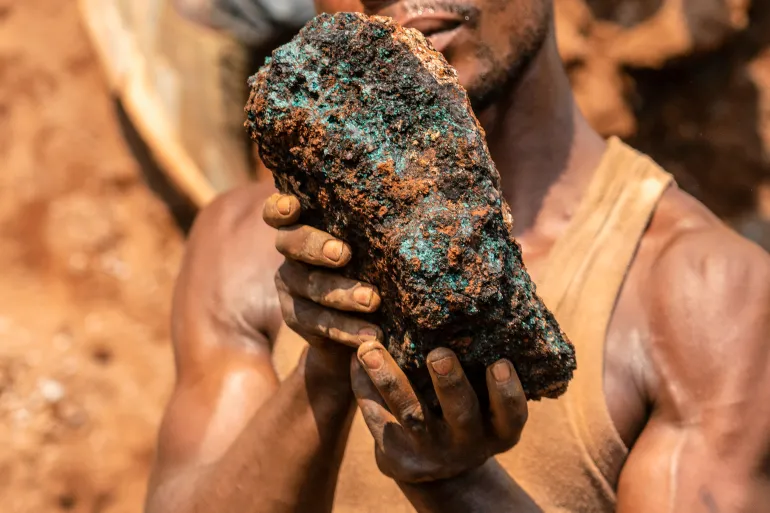
The Democratic Republic of Congo (DRC) is taking greater control over its cobalt exports.
Under new rules, unused export quotas from H1 2026 will be withdrawn and transferred into a state-controlled strategic quota. This move allows the government to redirect volumes towards projects deemed to be of national interest, including domestic processing and value addition.
According to a report conducted by GEM Mining Consulting, at first glance, it resembles another strategic stockpile. However, in reality, the DRC is pursuing something different.
Unlike countries which maintain reserves to protect domestic industries during supply shortages, such as Japan and the US, the DRC is using export controls to deliberately limit supply reaching the market.
Rather than preparing for disruption, it is attempting to influence prices, strengthen its bargaining position, and capture more value from the world’s largest cobalt resource.
The DRC is the world’s largest producer of mined cobalt, contributing 76.6% of global output. Indonesia recently emerged as the second-largest cobalt producer, accounting for 9.8%.
In 2024, global cobalt reserves were estimated at nearly 11.4 million tonnes, with the DRC holding the largest share of 52.8%, as reported by Natural Resources Canada.
Quotas are not the same as stockpiles
GEM Mining reports that an export quota determines how much cobalt can leave the country. A strategic reserve is something entirely different.
Reserves require physical material to be purchased or transferred, stored, financed, monitored, and, eventually, released.
For 2026, the DRC has set a total cobalt export quota of 96,600 tonnes, comprising 87,000 tonnes allocated to producers and a 9,600-tonne strategic quota controlled by regulators.
The DRC Government also has the ability to purchase surplus material and allocate strategic volumes to priority national projects.
However, GEM Mining notes that transferring unused export rights into a strategic quota does not automatically create a physical reserve.
As such, this creates an execution challenge — the DRC must decide who owns the material, who pays for it, where it is stored, in which chemical form, how quality is maintained, and under what conditions it can return to the market.
Critical minerals shift
The DRC’s approach reflects a broader trend, as resource-rich nations seek greater control over critical minerals.
According to the Organisation for Economic Co-operation and Development (OECD), export restrictions on critical raw materials remain near record levels. However, countries are pursuing different strategies to achieve similar goals.
From 2009–2024, export restrictions on ores and minerals increased more rapidly than those in other segments of the supply chain.
Between 2022 and 2024, in particular, on average, 16% of global trade in critical raw materials faced at least one export restriction, up from 12% in 2009–2011.
As previously reported, after an eight-month export ban, the DRC introduced a quota system in October 2025. The system capped cobalt exports at 96,600 tonnes a year for 2026 and 2027 — less than half the country’s 2024 output.
Cobalt prices have rallied close to 170% from their January 2025 lows. The question of which mines actually supply the world’s cobalt matters more than it has in a decade.
The OECD reports that several materials critical to industrial and energy-transition supply chains, including cobalt, face high exposure to export restrictions. Around 70% of global exports of cobalt and manganese were subject to at least one export restriction in 2022 and 2024.
GEM Mining says that Indonesia restricted exports of raw nickel ore to force investment into domestic processing and battery manufacturing.
China’s influence comes through its dominance of refining and processing capacity, supported by export licencing and industrial policy.
Meanwhile, countries such as Japan maintain strategic stockpiles to safeguard domestic manufacturers against supply chain disruptions.
GEM Mining adds that the DRC sits between these models, focusing on supporting prices and using supply control to encourage local value addition. In effect, the country strengthens its negotiating position in global markets.
Cobalt’s production challenges
Unlike many commodities, most cobalt produced in the Congo is done so as a by-product of copper.
This means producers cannot reduce cobalt output while increasing copper production. If exports are restricted but mining continues, surplus cobalt must be stored.
GEM Mining highlights that this presents logistical and financial challenges. Cobalt hydroxide requires controlled storage to maintain quality, while large inventories tie up working capital.
If producers hold the material, costs rise. If the government buys it, the financial burden shifts to the state. Furthermore, weak enforcement raises the risk of unofficial exports and quota leakage.
The challenge then becomes the DRC’s ability to finance, manage, and monitor the physical reserve behind.
Implications extend well beyond the DRC. As for battery manufacturers, refiners, and automakers, cobalt availability becomes increasingly shaped by government policy.
Buyers may respond by building inventories, securing long-term supply agreements, investing in alternative sources, expanding recycling, or reducing cobalt use.
That also carries a risk as lithium-iron-phosphate (LFP) batteries contain no cobalt and already account for a large share of the electric vehicle market. If cobalt prices rise too far, manufacturers have an even greater incentive to expedite the shift towards alternative battery chemistries.
GEM Mining says that the real opportunity is not to export less cobalt, but to use the current market position to build an industry that remains competitive as battery technologies and global supply chains evolve.
مقالات ذات صلة

Sanu Gold Announces $5 Million Private Placement L...
06 سبتمبر, 2024 13:08
Ivanhoe Mines produces 40,347 tonnes of copper at ...
09 سبتمبر, 2024 09:21
Andrada partners with SQM to develop Namibia lithi...
10 سبتمبر, 2024 08:56
US, Saudi Arabia in talks to secure metals in Afri...
10 سبتمبر, 2024 09:07
DRC: Eurasian Secures $150 Million to Develop a Co...
12 سبتمبر, 2024 06:22
Zambian mines desperate for power turn to a surpri...
13 سبتمبر, 2024 11:18
Africa at the cusp of a critical minerals boom...
17 سبتمبر, 2024 07:40
Coolabah to unite Broken Hill assets, paving path ...
17 سبتمبر, 2024 08:40
Marula Mining completes first manganese exports sa...
18 سبتمبر, 2024 09:05