مجالات التعدين الأخرى

Clean energy, dirty mining: Rights abuses rise across Africa


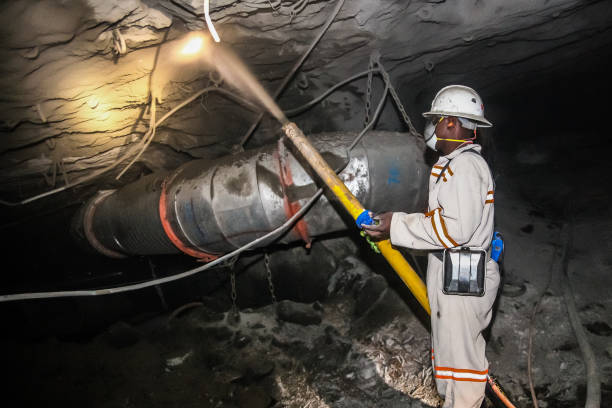
The race to extract critical minerals essential for clean energy is leading to an increase in rights abuses linked to major mining operations, the London-based non-profit the Business and Human Rights Centre said this week.
Its annual Transition Minerals Tracker reported 329 allegations of abuses worldwide in 2025, a 73 percent increase compared to 2024, and said Africa had seen the sharpest rise.
"This acceleration is unfolding at the same time that global powers are multiplying strategic mineral agreements with African governments," said Joseph Kibugu, Africa Regional Manager at the Business and Human Rights Centre.
The agreements, he said, were "often negotiated with little consultation with rightsholders and communities, and crucially, without binding human rights and environmental safeguards."
Africa saw 100 allegations of human rights abuses linked to the mining of transition minerals in 2025, according to the tracker, with just 10 large international mining companies associated with half the allegations.
Most allegations of abuse were recorded in two key mining countries, Zambia, a major copper producer, and the Democratic Republic of Congo (DRC), which produces three quarters of the world's cobalt.
CONFLICT MINERALS
In the DRC, the report said there were allegations that mining companies had directly enlisted law enforcement and the military to bolster their security.
"The military operates clandestinely both at industrial and artisanal mining sites. Paradoxically, the soldiers who were called in to expel artisanal miners are now reported to be participating in the illegal takeover of mining concessions," the report said.
The DRC last month announced plans to create a new paramilitary unit to protect its mines, that it said would be funded by the United States and United Arab Emirates. The United States denied it would fund such a group.
But rights groups say another paramilitary force could add to the issue of looting and lead to the violent displacement of local communities. One local rights group said in some areas around mines that were already militarised, residents report shooting and say soldiers man checkpoints to collect bribes.
The Congolese Ministry of Mines did not respond to requests for comment.
South Africa's Institute for Security Studies found evidence of rampant smuggling and corruption at DRC's cobalt mines, while mining company Eurasian Resources Group (ERG) has officially complained to the Congolese government about army generals it said were involved in looting at its mines.
The United States on Thursday announced sanctions against what it said were networks smuggling conflict minerals out of the DRC to support M23 rebels in the east of the country.
The M23, which the United States and others say is backed by neighbouring Rwanda, uses its control of mines in large parts of eastern DRC to help fund its forces.
Rights groups say the M23 has carried out a myriad of atrocities, including rape, torture and murder in an area now ravaged by the deadly ebola virus. Rwanda denies backing M23.
TRANSITION MINERAL BOOM
In Zambia, a dam collapse at the Sino-Metals Leach Zambia Copper Mine in February last year released at least 50 million litres (13 million gallons) of toxic material into a stream that feeds the country's main waterway, the Kafue River.
The river is a source of water for drinking, fishing and irrigation. Communities affected by the spill have filed a lawsuit against Chinese-owned Sino Metals, more than $80 billion for compensation and remediation.
The Southern African Litigation Centre, an NGO that works to advance the rule of law in the region, is directly involved in the Zambia lawsuit.
Executive Director Anneke Meerkotter agreed with the Business and Human Rights Centre's assessment that the race for green energy was spurring rights abuses across African mining countries.
"Africa's transition mineral boom is increasingly marred by environmental and human rights abuses, fuelled by a dangerous combination of weak government oversight and corporate disregard for local laws," she told the Thomson Reuters Foundation.
"As global demand for these critical minerals surges, advocates are calling for urgent accountability, warning that the green energy transition must not be built on a foundation of impunity and local exploitation."
(Editing by Jon Hemming)
مقالات ذات صلة
Endeavour announces transaction in own shares...
10 سبتمبر, 2024 07:27
Ivanhoe Mines Announces MOU with Government of Zam...
10 سبتمبر, 2024 12:24
Feasibility Study on Lumwana Super Pit Expansion E...
12 سبتمبر, 2024 14:21
Endeavour achieves commercial production at BIOX e...
13 سبتمبر, 2024 08:20
Roscan Gold Announces Changes to the Board of Dire...
16 سبتمبر, 2024 10:40
Minerals Council pays tribute to Pravin Gordhan...
16 سبتمبر, 2024 12:17
Notification of an acquisition of beneficial inter...
18 سبتمبر, 2024 08:39
Newmont on track to get at least $2 billion from a...
18 سبتمبر, 2024 10:49
UAE firm plans to invest $500m in Tanzania...
19 سبتمبر, 2024 08:37