Distribution

Burundi and Weza Power sign $1.4bn PPP to expand electricity access


By: OrePulse
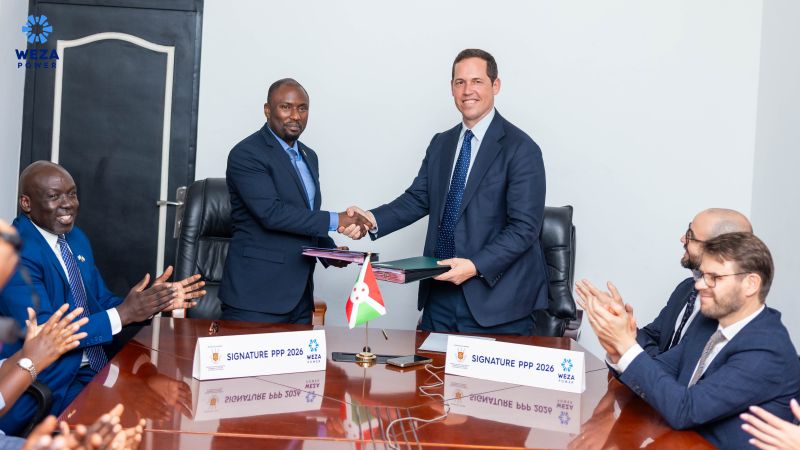
Burundi's government has signed a public-private partnership this week with Weza Power, a subsidiary of Anzana Electric Group, committing both sides to a 25-year agreement intended to mobilize roughly $1.4 billion for expanding electricity access across the East African nation. The deal aims to raise Burundi's electrification rate from about 15 percent to more than 50 percent by 2030, extending power to an estimated eight million additional people.
Under the deal, Weza Power will take charge of funding, upgrading and running the electricity distribution grid across roughly half of Burundi, while REGIDESO, the state utility, keeps control of the national transmission network and continues to manage generation and distribution in the other half of the country. Responsibility for reaching Burundian households is divided between the two, rather than the state utility being replaced outright.
The partnership is projected to add about 52,000 kilometers of new and upgraded distribution lines and connect more than 1.2 million additional households and businesses over the life of the concession. Officials said the buildout is expected to create more than 2,000 direct jobs and over 30,000 indirect jobs across construction, operations and related sectors.
President Évariste Ndayishimiye said electricity is "the foundation of Burundi's economic transformation and a key pillar of our Vision 2040-2060 ambitions."
Energy Minister Hassan Kibeya pointed to the country's existing generation base, noting that Burundi's installed capacity stands at approximately 183 megawatts. He said expanding access to that power, and to future generation, would help "power Burundi's industries, enable local processing of critical minerals" and support wider economic growth, framing the distribution upgrade as a necessary complement to generation capacity the country already has.
The financing structure combines private capital with concessional funding from multilateral and bilateral institutions, an approach officials said was designed to expand the grid without adding to Burundi's public debt. Named backers include the World Bank's ASCENT program, the International Finance Corporation, the Multilateral Investment Guarantee Agency and the African Development Bank, alongside the U.S. International Development Finance Corporation, Gridworks, part of British International Investment, the U.S. Trade and Development Agency, and Norway's development cooperation agency.
Babacar Sedikh Faye, the World Bank Group's country manager for Burundi, said "Mobilizing private capital is essential to creating jobs and expanding opportunities for Burundian families."
Brian Kelly, chief executive of Anzana Electric Group and Weza Power, said the partnership "will strengthen Burundi's ability to compete, attract investment and retain more value from its own resources."
The agreement forms part of Burundi's National Energy Compact, which falls under the Mission 300 initiative, a joint effort by the World Bank and the African Development Bank to connect 300 million people across Africa to electricity by 2030.
Anzana Electric Group's presence in Burundi dates to 2018, when it began operating in the country through its subsidiary Songa Energy, which runs a single hydropower plant there and is constructing a second one.
The 25-year concession makes Weza Power one of the larger private electricity-distribution operators to emerge in East Africa in recent years. Governments across the region have increasingly turned to public-private partnerships to close persistent electricity access gaps, pairing commercial investment with support from development finance institutions in an effort to spread the financial risk while limiting new sovereign borrowing.
For Burundi, where roughly one in seven people currently has access to grid electricity, the partnership represents one of the largest single commitments yet toward the government's stated goal of majority electrification within the decade. The 52,000 kilometers of lines envisioned under the deal would mark a substantial expansion of a national distribution network that today reaches only a small share of the population, concentrated mainly in urban centers.
Related Articles
US average diesel prices cross $5 a gallon as Midd...
17 Mar, 2026 08:34
Six African countries with cheapest petrol prices ...
17 Mar, 2026 08:56
Ghana Commissions LPG Tanker to Support Expansion ...
17 Mar, 2026 09:30
Ethiopia Intensifies Sustainable Energy Drive to M...
19 Mar, 2026 10:18
Saudi Aramco restarted Ras Tanura oil refinery on ...
19 Mar, 2026 10:25
Saudi Aramco-Exxon refinery SAMREF in Saudi Arabia...
19 Mar, 2026 11:09
Aramco lowers crude shipments to Asia for second s...
23 Mar, 2026 11:51
UAE's ADNOC Gas adjusts LNG output in response to ...
23 Mar, 2026 12:19
Uganda Cargo via Mombasa Climbs 25% to 10.91 Milli...
24 Mar, 2026 10:38