Mining Other

Museveni asks UPDF to help Uganda's anti-smuggling mining effort


By: OrePulse
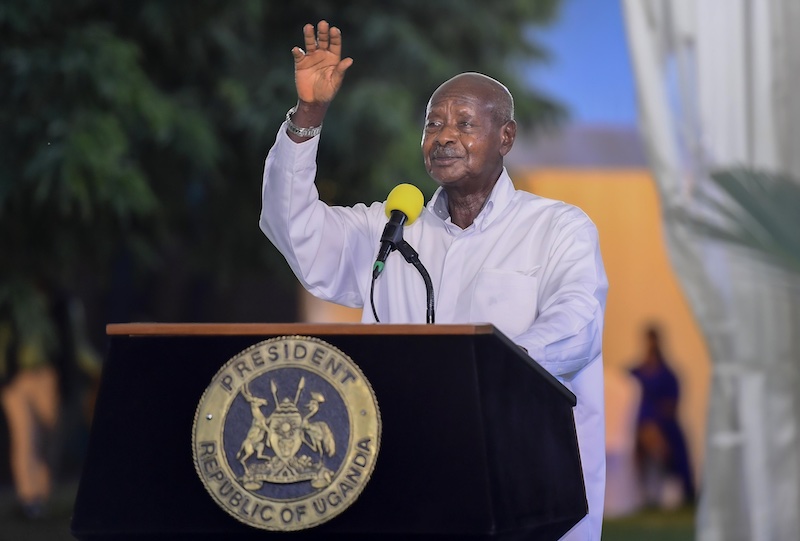
In a letter dated September 7, 2026, Uganda's President Yoweri Museveni asked the Uganda People's Defence Forces (UPDF) to assign a military officer to work with the Ministry of Energy and Mineral Development as part of an effort against illegal mining and mineral smuggling.
The letter, addressed to the Chief of Defence Forces at UPDF headquarters in Mbuya, asked that an officer be attached to the 2nd Division area to support the ministry's anti-smuggling work. According to the letter, Museveni said illegal mining and smuggling were undermining Uganda's iron-ore and steel, tin, and tungsten (wolfram) processing industries, and that the activity was depriving the state of tax income, jobs, and foreign-exchange earnings. He attributed some of the smuggling to "local parasites" and, he wrote, "possibly, also some external ones," without naming individuals, groups, or countries.
Museveni pointed to iron-ore deposits in southwestern and eastern Uganda, including at Muko and Butogota, and tin and wolfram deposits in the districts of Isingiro, Ntungamo, Rubanda, and Kisoro. He said domestic steel production could save the country $792 million a year in imports [uncertain, per source] and save the wider East African region $2.4 billion [uncertain, per source]. The letter's savings estimates are attributed to the president and have not been independently verified.
Museveni also compared the market value of raw and refined minerals, writing that a tonne of tin ore at 68 percent purity sells for about $20,000, compared with about $29,000 for a tonne refined to 99.85 percent, a gap he put at roughly $9,000 per tonne. He gave similar figures for wolfram, saying unprocessed ore of 65 percent purity brings in about $40,000 a tonne versus about $145,000 for concentrate refined to 99.9 percent. These price comparisons, like the savings estimates, are attributed to the president and have not been independently verified.
As an example of an investor losing out, the president named Woodcross Resources Ltd, which runs a tin-processing plant in Mbarara. He also questioned the practice of granting mining licenses to operators who lack any capacity to process the ore they extract, saying government policy favors adding value to minerals inside Uganda before they are exported, rather than shipping them out raw.
Museveni also proposed that the government consider compensation for customary landholders, known locally as bibanja holders, in cases where land must be cleared for mining or industrial development, and said local governments could hold shares in mining ventures where the law provides for it.
In the letter, Museveni explained part of his reasoning for seeking military involvement, writing, "the parasites sometimes use soldiers to protect their theft" — an apparent allegation that soldiers have at times been enlisted by illegal operators themselves.
The letter was copied to the Vice President, the Prime Minister, the Attorney General, the ministers for energy and mineral development and for lands, housing and urban development, and to several mining and steel companies, including Devki Steel Company and Balta Mining Africa Ltd. As of publication, no response to the letter had been reported from the UPDF, the Ministry of Energy and Mineral Development, or the companies named in it.
Related Articles
Oil prices seesaw as markets weigh IEA reserves re...
11 Mar, 2026 08:40
UN committee urges Ethiopia to address pollution a...
13 Mar, 2026 09:35
Boss Mining urges DRC authorities to tackle illega...
13 Mar, 2026 13:05
Building a responsive skills system for a changing...
16 Mar, 2026 07:36
Integrated water approach sets a benchmark for res...
16 Mar, 2026 07:45
Xylem launches total water treatment solution...
16 Mar, 2026 07:56
Transformation of Nigeria’s mining sector...
16 Mar, 2026 08:05
Dalaroo strengthens West African strategy with key...
16 Mar, 2026 08:15
Strengthening mining value chains to maximise Afri...
16 Mar, 2026 10:27