Energy Markets

Equatorial Guinea sees less than 7 blocks left, seeks Japan and US gas investment


By: OrePulse
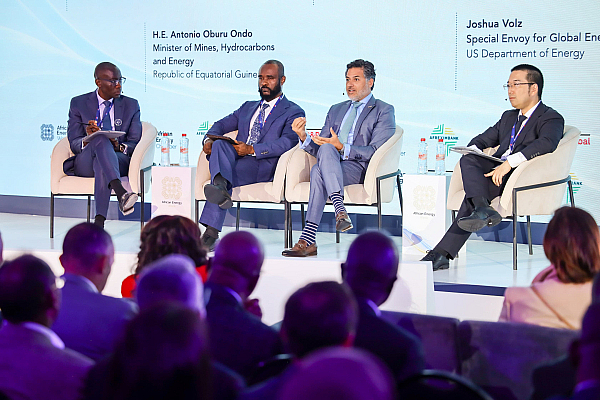
Equatorial Guinea has fewer than seven oil and gas exploration blocks left for award, down from more than 20 a year earlier, the country's minister of mines, hydrocarbons and energy said at African Energy Week in Cape Town.
Antonio Oburu Ondo told the Global Energy Leaders Forum, a panel moderated by Acha Leke, that most of the acreage awarded over the past year went to US and European firms, while Asian companies took a smaller share. "When I was here last year, we had more than 20 blocks available," he said.
The minister said the ministry made a decision in May to replace competitive licensing rounds with direct negotiations for remaining acreage, a change he credited with quickening the pace of recent deals.
Oburu Ondo used the forum to seek Japanese and US investment in the country's Gas Mega Hub, which gathers gas, including from the Yoyo-Yolanda resource shared with Cameroon, for processing at the EG LNG plant at Punta Europa. He said there was room to expand processing capacity and to build additional plants. "I can see the opportunity here of increasing the processing capacity," he said.
He also pointed to onshore liquefied petroleum gas storage as an investment opportunity, noting that Equatorial Guinea currently relies on a converted vessel for LPG storage. "One investment that is very clear that can be done is to build LPG storage in the mainland," he said.
Oburu Ondo said the EG-27 discovery is still available to investors, and that talks with ConocoPhillips about it remain non-exclusive.
The Japanese trading house Marubeni already holds a 6.067 percent interest in EG LNG, held through a UK-registered subsidiary.
On the same panel, Yasuhiro Hashimoto, a Japanese government official, said Japan sees Africa playing a growing role as an energy supplier, and that deeper cooperation would depend on a stable business environment.
Joshua Volz, representing the US Department of Energy, said American financing institutions are seeking closer partnerships on downstream projects in Africa, especially refining. "When the United States takes an equity position in a project, that's a long-term commitment," he said.
Oburu Ondo said that for capital-intensive projects, regulatory certainty and legal stability could weigh as heavily as local capital participation in drawing investors. He urged investors to move quickly. "This is the time to capture the momentum," he said, adding that the government wanted "to make sure that we are trusted, not only to attract businesses, but to keep the businesses in Africa."
Related Articles
Oil prices surge to $104.87 as Trump seeks naval c...
16 Mar, 2026 07:48
Oil prices recoup losses, surge to $102.85 as supp...
17 Mar, 2026 08:01
Oil prices contract by 2.21 percent to $101.13 fol...
18 Mar, 2026 11:34
Oil prices rise to $107.34 as investors balance ge...
23 Mar, 2026 08:30
Oil prices rise 4 percent to $99.92 on renewed sup...
24 Mar, 2026 08:50
Oil prices plunge over 4 percent to $95.77 on easi...
25 Mar, 2026 08:12
Oil prices surge 2.37 percent to $107.82 as Strait...
30 Mar, 2026 10:51
Oil prices drop 0.03 percent to $107.36 as markets...
31 Mar, 2026 07:30
Oil prices surge 1.34 percent to $105.36 as market...
01 Apr, 2026 07:07