Marchés de l’énergie

Saudi pipeline restart eases Hormuz-driven oil supply crunch


By: OrePulse
Saudi Arabia has restarted its East-West Pipeline at partial capacity, days after a drone attack forced the line offline and pushed the kingdom to reroute its oil exports around a bottleneck at the Strait of Hormuz.
State-owned Saudi Aramco began pumping crude through the pipeline again on Tuesday, after the attack knocked out three of its eleven pumping stations more than a week earlier. The pipeline normally links oil fields in the kingdom's Eastern Province to export terminals on the Red Sea coast and has a rated capacity of about 7 million barrels a day.
The pipeline outage forced Saudi Arabia to reroute its crude exports through the Strait of Hormuz at a moment when that waterway was already under heavy strain from the wider standoff between Iran and Western and Gulf governments. Before the drone strike, the East-West line had been carrying a volume of crude equivalent to roughly 4% of global oil supply, making its restoration a closely watched signal for how quickly Gulf export capacity can normalize.
Aramco expects the line to reach roughly 40% of capacity, or about 4 million barrels a day, within days, and anticipates it will need six to eight weeks before operations are fully back to normal.
The first cargo bound for China was scheduled to load at the Red Sea port of Yanbu the evening after the restart, and Aramco has informally told Asian refiners it will soon be able to resume collecting crude from that port.
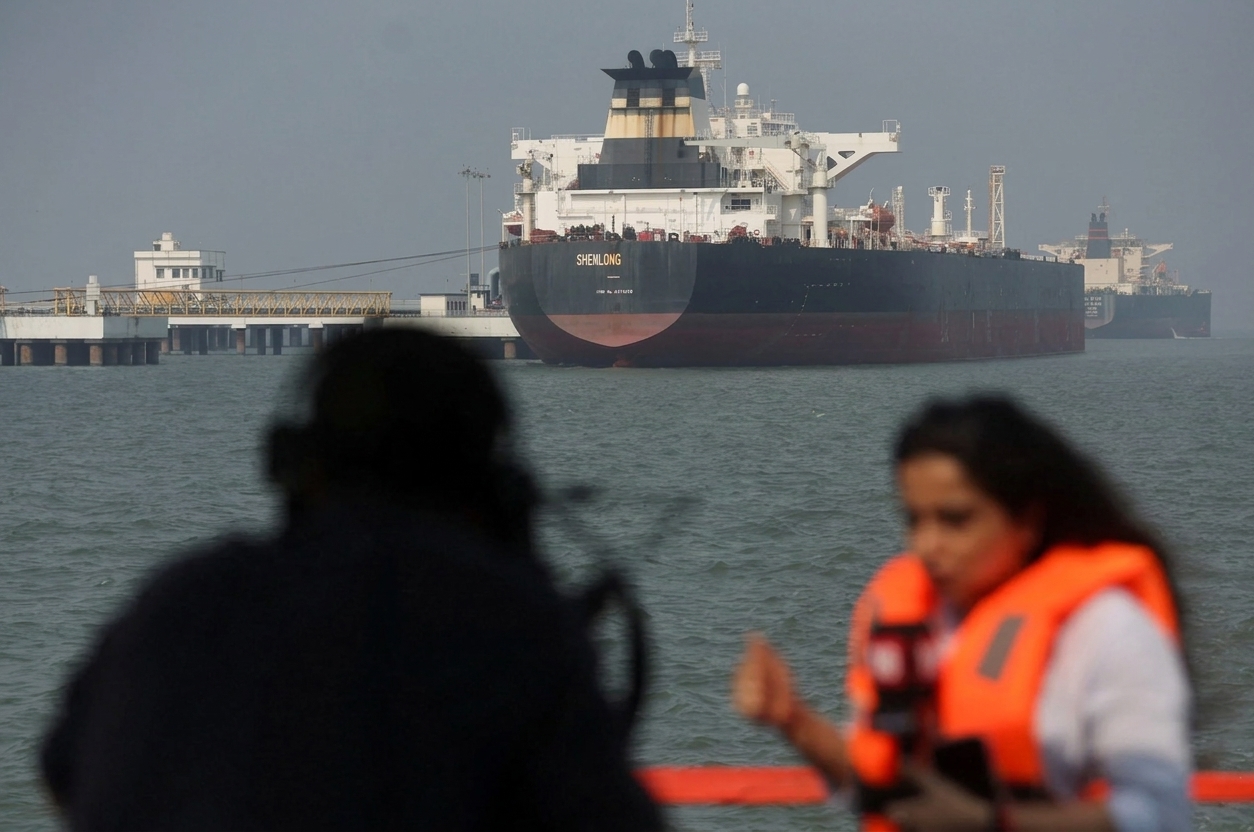
During the outage, Aramco kept crude moving by rerouting supply through the Strait of Hormuz via the eastern port of Ras Tanura, arranging roughly 60 million barrels for delivery in September and October and transferring some cargoes ship-to-ship near Sohar, in Oman, for Asian buyers. Only two commodity vessels transited the strait on Monday, versus a pre-crisis daily average of about 125 large commercial vessels, highlighting how constrained the waterway had become during the outage.
In Egypt, shipping traffic has begun shifting toward Port Said, where vessels are handling ship-to-ship transfers, and toward the Sidi Kerir terminal on the Mediterranean coast, where tankers are loading Saudi crude as flows pick back up around the Hormuz chokepoint.
The disruption has hit European refiners harder than their Asian counterparts. At least two European refiners have been told they will receive no Saudi crude under long-term supply contracts for October, while Asian buyers were largely able to secure alternative volumes through the Hormuz reroute and ship-to-ship transfers.
Oil prices initially fell on news of the restart, with Brent crude dropping more than $2 a barrel to around $97, its lowest level since September 8, as traders priced in the prospect of increased Middle Eastern supply. Prices later recovered some ground, with Brent trading near $100.30 a barrel and West Texas Intermediate near $90.82 a barrel by Wednesday afternoon, as other developments in the wider Iran standoff added back some risk premium.
Daniela Hathorn, an analyst at Capital.com, said a credible agreement to reopen the strait, combined with a continued recovery in Saudi exports, "could push Brent towards the low $90s, as markets price a more normal supply environment." She added that "if negotiations break down or another round of attacks damage Saudi infrastructure, tankers or Gulf export capacity, the geopolitical premium could return very quickly."
Salih Yilmaz, an analyst at Bloomberg Intelligence, said "the restart of Saudi Arabia's East-West pipeline and signs of better flows through Hormuz both reduce the immediate risk of a severe supply squeeze," adding that "renewed diplomacy adds further downside pressure."
Traders and refiners are now watching for whether vessel traffic through Hormuz itself picks back up toward pre-crisis levels, and for progress in the broader diplomatic talks involving Iran, as the next signals of whether the supply crunch is easing for good or only temporarily.
Articles similaires

Oil prices jump over 3 percent to $84.41 as supply...
05 mars, 2026 07:30
Oil prices fall 1 percent to $84.56 as U.S. grants...
06 mars, 2026 07:40
Oil prices drop to $86.98 on report of IEA plannin...
11 mars, 2026 07:16
Oil prices surge back above $100 as Mideast tensio...
12 mars, 2026 08:07
Oil gains 9 percent this week as prices remain abo...
13 mars, 2026 07:50
Oil prices surge to $104.87 as Trump seeks naval c...
16 mars, 2026 07:48
Oil prices recoup losses, surge to $102.85 as supp...
17 mars, 2026 08:01
Oil prices contract by 2.21 percent to $101.13 fol...
18 mars, 2026 11:34
Oil prices rise to $107.34 as investors balance ge...
23 mars, 2026 08:30