مجالات التعدين الأخرى

South Africa’s first utility-scale solar plant on rehabilitated mine land signals new era for sustainable mining and clean energy transition


By: Africa Sustainability Matters
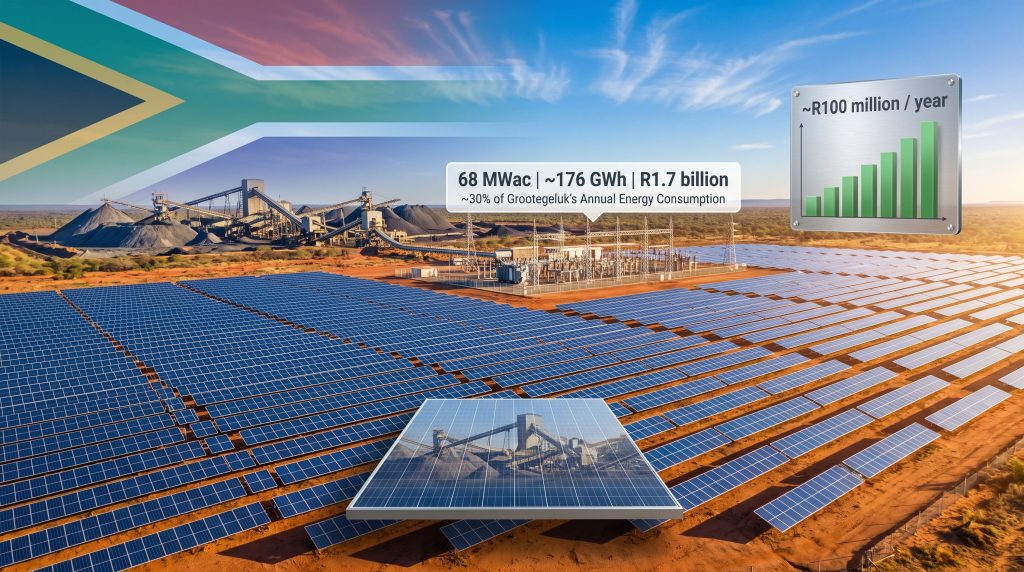
South Africa has taken another step toward integrating renewable energy into its mining sector after Envusa Energy reached financial close for a 63-megawatt (MW) solar power project that will supply electricity directly to Kumba Iron Ore’s Sishen mine in the Northern Cape. The project, announced on 23 July, is set to become the country’s first utility-scale solar facility constructed on a rehabilitated mine waste dump within an active mining operation, marking a significant milestone in the evolution of sustainable mining, land rehabilitation and industrial decarbonisation.
The development reflects a broader shift taking place across Africa’s mining industry, where companies are increasingly investing in renewable energy not only to lower operating costs and reduce carbon emissions but also to improve energy security in markets facing persistent electricity supply challenges. Once operational in the fourth quarter of 2027, the facility will have an installed photovoltaic capacity of 72.5 megawatt-peak (MWp) and will generate 63MW of electricity exclusively for the Sishen iron ore mine through a dedicated private connection, without relying on South Africa’s national electricity grid.
Although Envusa Energy did not disclose the project’s total investment value or financing partners, the successful financial close underscores growing investor confidence in renewable energy projects serving large industrial consumers through private power purchase agreements. Across Africa, mining companies are increasingly becoming anchor customers for renewable energy developments as governments liberalise electricity markets and encourage greater private sector participation in power generation.
The Sishen project also introduces an innovative approach to mine rehabilitation by transforming previously disturbed mining land into productive clean energy infrastructure. The solar plant will occupy approximately 100 hectares atop a rehabilitated waste rock dump composed of excavated rock and soil with little or no economically recoverable mineral content. According to Envusa Energy, the project will be the first of its kind in South Africa to deploy utility-scale solar infrastructure on rehabilitated mine waste within an operational mining site.
This approach illustrates how former mining assets can be repurposed to generate long-term economic value after extraction activities have altered the landscape. Rather than leaving rehabilitated land underutilised, renewable energy infrastructure provides an opportunity to extend the productive life of mining sites while supporting environmental restoration objectives.
Engineering solutions have been incorporated to address the technical complexities associated with building on rehabilitated mining terrain. Envusa stated that adjustable photovoltaic mounting systems and a mobile electrical substation will accommodate potential ground movement, ensuring long-term operational stability while maintaining safety standards.
The project comes at a time when South Africa continues to accelerate reforms aimed at expanding renewable energy generation and improving electricity reliability. According to the International Energy Agency (IEA), South Africa remains Africa’s largest electricity producer but continues to face significant generation shortfalls resulting from ageing coal-fired power stations, maintenance backlogs and rising electricity demand. These challenges have contributed to years of load shedding, prompting industrial companies to increasingly invest in self-generation capacity.
Mining companies have emerged among the country’s largest investors in renewable energy as they seek greater operational certainty while reducing exposure to grid instability. According to the Minerals Council South Africa, reliable electricity remains one of the mining sector’s most critical operational requirements, particularly for energy-intensive commodities such as iron ore, platinum and copper.
For Kumba Iron Ore, securing dedicated renewable electricity through the Sishen solar project could improve operational resilience while contributing to the company’s broader decarbonisation strategy. Iron ore production is central to South Africa’s mining exports and industrial economy, making energy security essential for maintaining international competitiveness.
The project also reflects the evolving role of mining companies in supporting South Africa’s climate commitments. While Sishen is an iron ore operation rather than a coal mine, repurposing mining land for renewable energy aligns with the objectives of South Africa’s Just Energy Transition Investment Plan (JET-IP), which seeks to diversify the country’s energy mix, reduce greenhouse gas emissions and create alternative economic opportunities in regions historically dependent on extractive industries.
According to the Presidential Climate Commission, the Just Energy Transition is intended not only to reduce emissions but also to ensure that communities affected by structural changes in the energy sector participate in new economic opportunities created through clean energy investments.
That community dimension is embedded within the Sishen solar project through the participation of the Sishen Iron Ore Company Community Development Trust (SIOC-CDT), which will hold a 10% equity stake in the development. Dividend revenues generated from the project are expected to finance local programmes in education, healthcare, infrastructure development, employment creation and skills training across surrounding communities.
Community ownership models are becoming increasingly important across renewable energy developments in South Africa. According to the World Bank and the African Development Bank, incorporating local equity participation into infrastructure projects can strengthen social acceptance while ensuring that host communities receive long-term economic benefits beyond temporary construction employment.
The Sishen development forms part of Envusa Energy’s wider renewable energy portfolio. The company, a joint venture between Anglo American and EDF power solutions, is also developing the Koruson 2 renewable energy complex, combining wind and solar generation with a planned capacity of 520MW to supply electricity to multiple mining operations across South Africa.
These investments reflect broader trends across the global mining industry. According to the International Renewable Energy Agency (IRENA), renewable energy has become increasingly competitive for mining operations due to substantial declines in solar photovoltaic and battery storage costs over the past decade. Renewable electricity enables mining companies to reduce exposure to volatile fossil fuel prices while supporting environmental, social and governance (ESG) commitments demanded by international investors and commodity buyers.
Across Africa, renewable energy deployment within mining is expanding beyond South Africa. Mining companies operating in Namibia, Zambia, Botswana, the Democratic Republic of Congo and Ghana are increasingly integrating solar, wind and battery storage systems into their operations to reduce diesel consumption, improve reliability and lower operating costs.
According to the African Development Bank (AfDB), mining can play a catalytic role in expanding renewable energy markets by creating stable, long-term electricity demand capable of supporting private investment in generation infrastructure. In many remote regions, renewable energy projects initially developed for mines may eventually support surrounding communities and other productive industries as transmission networks expand.
For South Africa, projects such as Sishen demonstrate how renewable energy, industrial competitiveness and environmental rehabilitation can increasingly reinforce one another. Rather than viewing mine closure and land restoration solely as environmental obligations, developers are beginning to integrate renewable energy into long-term land use strategies that create enduring economic value.
As Africa’s mining sector responds to rising global demand for responsibly produced minerals required for the clean energy transition, integrating renewable energy into mining operations is likely to become an increasingly important component of sustainable resource development. The Sishen solar project illustrates how innovation in land rehabilitation, community participation and clean energy investment can collectively strengthen industrial resilience while supporting broader climate and economic transformation objectives.
مقالات ذات صلة
Endeavour announces transaction in own shares...
10 سبتمبر, 2024 07:27
Ivanhoe Mines Announces MOU with Government of Zam...
10 سبتمبر, 2024 12:24
Feasibility Study on Lumwana Super Pit Expansion E...
12 سبتمبر, 2024 14:21
Endeavour achieves commercial production at BIOX e...
13 سبتمبر, 2024 08:20
Roscan Gold Announces Changes to the Board of Dire...
16 سبتمبر, 2024 10:40
Minerals Council pays tribute to Pravin Gordhan...
16 سبتمبر, 2024 12:17
Notification of an acquisition of beneficial inter...
18 سبتمبر, 2024 08:39
Newmont on track to get at least $2 billion from a...
18 سبتمبر, 2024 10:49
UAE firm plans to invest $500m in Tanzania...
19 سبتمبر, 2024 08:37