Energy Markets

Oil prices surge 0.28 percent near one-week highs at $87.97 as Hormuz negotiations lose momentum


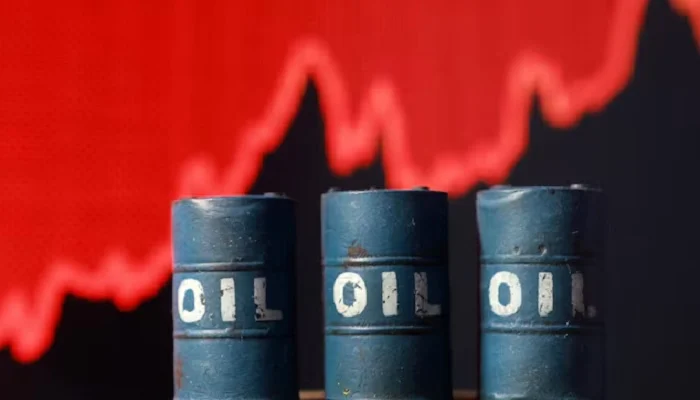
Oil futures held close to their highest levels in more than a week on Tuesday morning as diminished expectations for a U.S.-Iran peace agreement kept attention on the Strait of Hormuz and the outlook for regional supply. The market steadied after both major benchmarks climbed more than 5 percent in the previous session during early Asian trading hours.
Brent crude futures rose 0.28 percent to $87.97 a barrel by 9:29 UAE time. U.S. West Texas Intermediate crude futures edged 0.33 percent higher to $82.40 a barrel.
Despite the modest pullback, Brent and WTI remained near their highest levels since July 31. Their Monday rally followed a new exchange of demands between Washington and Tehran that reduced optimism about an agreement to end the war and reopen the strategically important waterway.
U.S. President Donald Trump responded to Iran’s proposed conditions by demanding compensation for people killed in wars, attacks and protests. The additional demand appeared likely to complicate negotiations over a settlement and the restoration of regular shipping through Hormuz.
Trump later said the United States controlled the strait and that the U.S. Navy had completed operations to clear Iranian mines from the oil transit route.
Tim Waterer, chief market analyst at KCM Trade, said the positions of the United States and Iran remained far apart over the form of any agreement. He added that part of the optimism accumulated during the previous week was being reversed, giving oil prices renewed support.
Shipping constraints persist
Supply concerns were reinforced by developments around another major regional shipping corridor. Saudi Aramco postponed the restart of its 400,000-barrel-per-day Jazan refinery until August 30 after Yemen’s Houthis claimed responsibility for two attacks on the facility on Sunday.
Waterer said risks surrounding both the Strait of Hormuz and Bab el-Mandeb remained significant. Even intermittent restrictions or the possibility of additional incidents could keep insurance costs elevated, require vessels to use longer routes and constrain energy flows in the near term.
Physical export data also pointed to reduced movement through Hormuz. Barclays analysts estimated that net exports of crude oil and refined products through the strait averaged 3 million barrels per day during the week ending August 7, down from 4.4 million barrels per day in the previous week.
ADNOC continued working to market oil located inside the Strait of Hormuz. The UAE energy company offered spot crude through a tender, representing its eighth such tender since the beginning of June as it sought to move barrels from within the waterway.
The session therefore reflected a balance between continuing alternative flows and persistent geopolitical risk. Limited price changes on Tuesday did not reverse Monday’s rally, with negotiations, tanker security, export volumes and refinery operations remaining the main influences on the immediate direction of oil futures.
Market forecasts shift
The latest move fits within a broad trading range created by competing diplomatic and supply signals. Goldman Sachs said Brent could remain between $80 and $90 a barrel until either a U.S.-Iran agreement is confirmed or the conflict escalates materially. Its market assessment placed fair value near $80 but said physical conditions were tightening. Visible global inventories had fallen by an estimated 6.3 million barrels per day over two weeks, while Gulf exports stood at about 36 percent of prewar levels. Russian crude and condensate exports had also declined by 1.3 million barrels per day. Red Sea tanker capacity had fallen 22 percent.
Supply has begun recovering in parts of the producer group, although access to export routes remains uneven. A Reuters survey estimated that OPEC production increased by 1.17 million barrels per day in July to 19.85 million barrels per day, led by Iraq, Kuwait and Iran. The increase followed exceptionally weak May output as Gulf producers restored operations and shipping. Iran’s exports slowed again after the United States reimposed its blockade in mid-July, while the UAE was excluded from the OPEC total following its departure from the organization on May 1. Libya also increased production despite regional operational uncertainty.
Fuel pressures widen
Before the latest diplomatic setback, the U.S. Energy Information Administration expected worldwide production and trade to move close to pre-conflict levels by year-end. Its July outlook forecast average Brent prices of $82 a barrel for 2026 and $65 in 2027, with U.S. crude production rising from 13.8 million barrels per day in 2026 to 14 million in 2027. It also projected a third-quarter Brent average of $74. The price near $88 therefore demonstrates how renewed political and maritime risks can quickly challenge assumptions based on a sustained reopening of the strait. That forecast assumed the June agreement continued supporting higher traffic.
Pressure is also visible in refined fuels. U.S. ultra-low-sulfur diesel futures jumped 7.4 percent on Monday, while European diesel margins rose nearly 10 percent as refinery attacks, Russian export restrictions and constrained Middle Eastern flows tightened supply. U.S. distillate inventories stood at 107.2 million barrels, their lowest seasonal level in 30 years, according to a diesel market report. Demand remains another counterweight. July crude imports into China recovered from June but remained 24.3 percent below the previous year, showing how high prices and available inventories can restrain purchases during prolonged disruption. That demand response could limit further gains.
Hormuz disruption deepens
The Strait of Hormuz has long been central to global energy trade. U.S. Energy Information Administration data show that 20.7 million barrels per day of crude oil and petroleum liquids passed through the waterway in 2024, rising to 20.9 million barrels per day during the first half of 2025. That represented roughly one-quarter of global seaborne oil trade. The chokepoint data also show that 10.1 billion cubic feet of LNG moved through Hormuz each day in 2024, making restrictions important to oil, refined-product and natural-gas markets.
After the Middle East conflict began on February 28, 2026, the International Energy Agency described the disruption as unprecedented and coordinated its largest emergency stock release. The agency’s 32 members agreed to make 400 million barrels available, including 172 million barrels authorized by the United States. The IEA said oil exports through Hormuz had fallen below 10 percent of their pre-conflict level. It was the IEA’s sixth coordinated release since 1974 and followed earlier interventions in 1991, 2005, 2011 and twice in 2022.
A June 18 memorandum of understanding between Washington and Tehran temporarily improved expectations for reopening the strait. The EIA said shipping had increased and forecast that disrupted production would return by early 2027. Its recovery forecast lowered projected third-quarter Brent prices to $74 a barrel. Renewed hostilities, blockades and conflicting compensation demands have since weakened confidence in that timetable. The movement back toward $88 illustrates why oil prices remain sensitive to every statement, maritime incident and change in export flows
Related Articles

Oil prices recoup losses, surge to $102.85 as supp...
17 Mar, 2026 08:01
Oil prices contract by 2.21 percent to $101.13 fol...
18 Mar, 2026 11:34
Oil prices rise to $107.34 as investors balance ge...
23 Mar, 2026 08:30
Oil prices rise 4 percent to $99.92 on renewed sup...
24 Mar, 2026 08:50
Oil prices plunge over 4 percent to $95.77 on easi...
25 Mar, 2026 08:12
Oil prices surge over 5 percent to $107 on Mideast...
02 Apr, 2026 08:38
Oil prices surge 0.59 percent to $109.67 as Strait...
06 Apr, 2026 07:40
Oil prices surge 1.65 percent to $111.58 following...
07 Apr, 2026 08:39
Oil prices plunge 13.61 percent to $94.40 followin...
08 Apr, 2026 08:27