Sea

Durban ship queue tops 11 days as Ngqura, Cape Town volumes climb


By: OrePulse
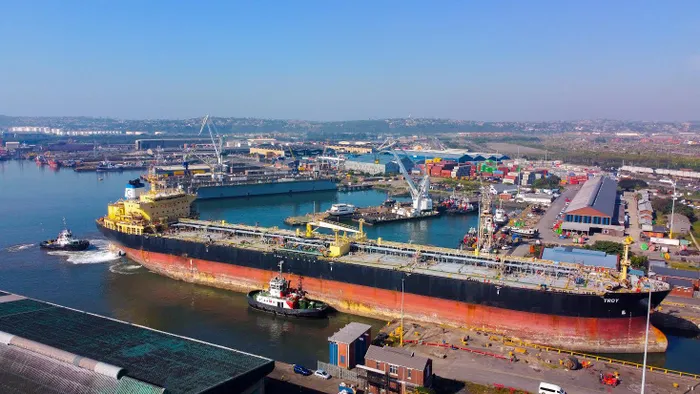
DURBAN — Congestion at South Africa's busiest container gateway continued through mid- to late October, with 10 to 12 ships waiting at anchor off Durban and average delays stretching past 11 days, according to a cargo-movement update prepared by the South African Association of Freight Forwarders (SAAFF) and circulated by Business Unity South Africa (BUSA), even as volumes kept shifting toward the Ngqura and Cape Town terminals.
Durban Gateway Terminal moved 28,617 twenty-foot equivalent units (TEUs) in the week of 12 to 18 October, equal to about 4,088 a day and a 14 percent drop from the prior week, the update said. Roughly 11 vessels sat offshore awaiting berths during that period, with ships anchored for an average of 274 hours — more than 11 days — before coming in. A follow-up update dated 22 October reported daily throughput near 3,300 moves, stack occupancy of 55.3 percent, and 10 to 12 vessels still at anchor.
Three ship-to-shore cranes at Durban's Pier 1 were out of service during the period, the update said, leaving four cranes running across two berths. At a throughput of roughly 3,300 to 3,400 container moves a day, the terminal was largely matching incoming cargo rather than cutting into the existing backlog; even lifting output to 4,600 moves a day would take about a month to clear the queue, according to the update.
Other terminals picked up volume as cargo diverted away from Durban. Ngqura Container Terminal, on the Eastern Cape coast, handled 19,062 TEUs, or roughly 2,723 a day, a 10 percent decline from the previous week that nonetheless left it as the country's second-busiest container terminal; vessels there spent an average of 2.6 days at anchor and 3.3 days at berth, the update said. Cape Town Container Terminal processed 15,288 TEUs — about 2,184 a day and a 35 percent jump — with anchorage waits averaging 0.7 days and berth time of 3.2 days. Port Elizabeth Container Terminal saw the sharpest swing, volumes jumping 464 percent to 7,935 TEUs — a gain the update attributed in part to cargo that had previously been routed elsewhere coming back through the terminal. Nationally, container terminals handled 90,885 TEUs for the week, a 2 percent rise, for a daily average of 12,984 TEUs.
Landside, rail volumes leaving Durban fell 33 percent to 1,269 containers for the week, the update said. On the N4 corridor to Maputo, Mozambique, train movements averaged 1.5 a day while truck crossings slipped about 2 percent to 1,396 a day. Average border queue times eased to around five hours, a 9 percent improvement, and processing time dropped 21 percent to roughly 4.2 hours, though the queue at the Lebombo crossing still reached about 15 kilometers on 15 October. Uncertainty over a Mozambican requirement that trucks carry three spare tires also continued to affect crossings, the update said. Elsewhere in the region, Southern African Development Community border queues averaged 7.4 hours, the median crossing time at South African borders was 8.3 hours, down 4 percent, and the Kasumbalesa crossing on the Democratic Republic of Congo border could take about five days from the Zambian side, according to the update.
SAAFF and BUSA put the week's indirect cost of logistics delays at approximately 736 million rand, down from 843 million rand the previous week. The update also cited the State of Logistics 2026 report's projection that South Africa's logistics costs could reach 1.156 trillion rand, equal to 14.6 percent of gross domestic product, and referenced Alphaliner estimates that 63 percent of deployed Far East-to-Europe shipping capacity now runs on services routed via the Red Sea, a capacity measure the update noted does not necessarily reflect the share of vessels actually transiting the canal.
Related Articles
Saudi Arabia’s Mawani introduces new service to co...
17 Mar, 2026 08:05
MSC, Nigerdock sign long-term development deal for...
17 Mar, 2026 09:40
One in 10 Gulf ships cannot be reliably tracked, a...
19 Mar, 2026 07:55
GCC launches logistics fast track route...
19 Mar, 2026 10:45
Qatar activates exceptional package of facilitatio...
19 Mar, 2026 10:49
Africa quietly becomes the new center of global sh...
23 Mar, 2026 10:34
Saudi Arabia expands shipping services via Red Sea...
23 Mar, 2026 11:55
Saudi ports add five new shipping services amid Ho...
23 Mar, 2026 12:09
African bunkering hubs gain as ships reroute aroun...
24 Mar, 2026 12:24