Precious Metals

Sudan gold production surges during war as smuggling drains economy


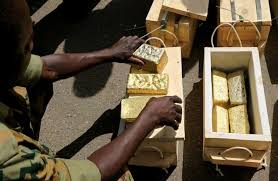
A sharp paradox has emerged in Sudan’s gold sector as the country grapples with ongoing conflict. While production surged to a record 70.15 tons between 2023 and 2025, official government channels recorded only a small fraction of that as exports, revealing a massive leak in the national economy.
More than 55 tons of gold have vanished into a shadow economy, bypassing the state treasury. With artisanal mining and parallel markets now controlling more than 80% of the industry, Sudan’s sovereign wealth is increasingly being diverted to finance unregulated activities across unguarded borders, depriving the state of billions of dollars in much-needed revenue.
Widening gap in official figures to Agence France-Presse, he noted that only 20 tons of gold were exported through formal channels out of the 70 tons produced in 2025. This discrepancy underscores the challenge the government faces in maintaining control over its most valuable resource during wartime.
A source within the Sudanese Mineral Resources Company, speaking to Sudan Tribune on condition of anonymity, said the sector has faced extreme volatility since the conflict began. Production plummeted to just 6.4 tons in 2023 when the war first broke out, before rebounding to last year’s record high. However, the source noted that only 12.5 tons of that total entered the public treasury as official exports. The source explained that smuggling networks that existed before the war have significantly expanded their operations amid the current instability.
Shadow networks and the war economy
The same source indicated that more than 80% of total production has been smuggled abroad since 2023. He pointed to the rise of “shadow networks” and a burgeoning war economy that maintains deep ties with various parties to the conflict. The high rates of smuggling are attributed to a total lack of government oversight in mining regions and the increasing involvement of armed movements in unregulated extraction.
The formal infrastructure of the trade has also suffered. Haitham Tabidi, a member of the Gold Exporters Union, told Sudan Tribune that most established gold-producing companies are currently dormant or operating at half capacity. Because vital institutions such as the national gold refinery are closed, the state lacks the mechanisms to capture and record the returns these companies would typically provide.
The struggle for government control
Tabidi explained that while artisanal mining accounts for the vast majority of Sudan’s gold production, the state has no actual control over the sector. He argued that combating smuggling requires more than just security; it necessitates sound economic policies, incentive pricing for producers, and the secured flow of gold from mines to central markets. However, the country’s vast geography and porous borders make enforcement an uphill battle.
According to Sudan Tribune’s monitoring, many traders prefer to transport raw gold to Egypt, where they face lower taxes and a lower risk of confiscation. Atef Ahmed, secretary-general of the Goldsmiths, previously stated that neighbouring countries benefit significantly from this illegal flow. He blamed conflicting government policies and a slow bureaucratic cycle for pushing legitimate exporters toward the black market.
Conflicting data and international concern
Some industry observers believe the official production figures may even be conservative. One source suggested that actual production could be closer to 100 tons, with 90% coming from the artisanal sector. While the Sudan Gold Refinery has recently introduced incentive pricing to encourage formal sales, technical reports suggest that up to 60% of gold continues to exit the country through land borders and unmonitored airports.
The international dimension of this drainage is significant. A 2025 report by the organization Swissaid revealed the involvement of regional networks in siphoning Sudanese gold, documenting a 70% increase in informal flows to the United Arab Emirates in 2024 alone. Neighbouring countries like South Sudan, Chad, and Ethiopia have reportedly become transit hubs where Sudanese gold is relabeled before reaching global markets, effectively turning the precious metal into a primary fuel for the continuation of the armed conflict.
| Year | Total Estimated Production | Official Exports | Smuggling Gap (Estimated) |
| 2023 | 6.4 tons | Negligible | Large percentage (war outbreak) |
| 2025 | 70.15 tons | 12.5 tons | 57.65 tons |
| 2025 (Alternate Est.) | ~100.0 tons | 50.0 tons | ~50.0 tons |
Related Articles

Investigation uncovers fraudulent identity documen...
10 Sep, 2024 08:08
The Top Five Gold-Producing Countries in Africa in...
10 Sep, 2024 08:46
AngloGold notes ‘enormous geological potential’ in...
10 Sep, 2024 09:29
Awalé Resources expands BBM gold zone at Odienné p...
10 Sep, 2024 11:38
Proposed amendment: Gold mines to be subject to th...
10 Sep, 2024 12:39
Pan African Resources Annual Result Improves; Expe...
12 Sep, 2024 07:42
African countries are joining the sovereign gold-b...
12 Sep, 2024 08:07
Platinum Group Metals Ltd. Announces Positive Inde...
16 Sep, 2024 09:11
At least 20 likely dead in violence near Papua New...
16 Sep, 2024 10:37