Energy Other

How U.S., Chinese Investment Models Are Reshaping Nigeria's Trade, Energy Sector


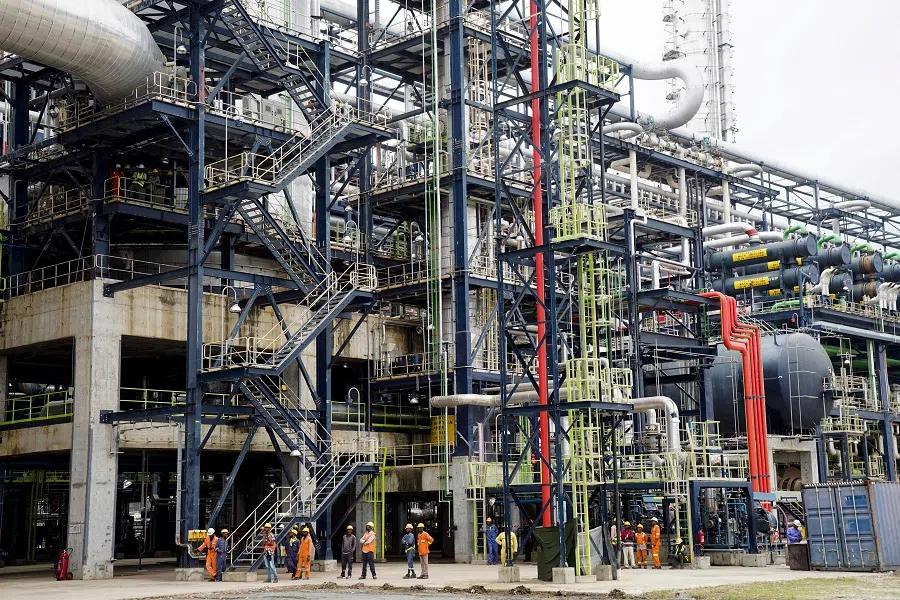
Nigeria is currently the United States' second-largest trading partner in Africa. Bilateral trade in goods and services reached nearly $13 billion in 2024.
When the United States and Nigeria signed a landmark Commercial and Investment Partnership (CIP) in Washington in July 2024, the announcement attracted little fanfare. There were no dramatic declarations, no contest of flags.
But the five-year framework, backed by the US Department of Commerce, the US Department of Agriculture, and a web of American trade and development finance agencies, has since grown into one of the most consequential economic arrangements Nigeria has entered into in recent history.
It is also the clearest articulation yet of how Washington intends to compete with Beijing for influence and investment in Nigeria: not by outspending China's state-backed loan apparatus, but by building commercial frameworks, leveraging private capital, and supporting reforms aligned with Nigerian priorities.
A new kind of partnership
The CIP ministerial meeting in Lagos in January brought together a high-level American interagency delegation of trade financing, trade promotion, and project development experts. They reviewed priority reforms recommended by working groups comprising US and Nigerian private sector leaders.
The numbers tell part of the story. Nigeria is currently the United States' second-largest trading partner in Africa. Bilateral trade in goods and services reached nearly $13 billion in 2024.
US foreign direct investment in Nigeria rose to $7.9 billion in the same year, a 25 per cent increase from 2023, making the United States one of Nigeria's top foreign investors.
US Deputy Assistant Secretary for the Commercial Service at the Department of Commerce, Bradley McKinney, said the working groups had "developed thoughtful, practical proposals to unlock trade and deepen the bilateral commercial relationship between the United States and Nigeria."
Nigeria's Minister of Industry, Trade and Investment, Jumoke Oduwole, who co-chaired the session, described the engagement as timely and aligned with the economic reform agenda of President Bola Tinubu.
The focus on infrastructure, agriculture, and the digital economy, she said, "reflects areas where both countries are strong and where collaboration can unlock investment, support private businesses, and expand Nigeria's role as a trade hub across Africa."
Ms Oduwole said a central priority was to "accelerate non-oil export diversification" and ensure Nigerian businesses could access US markets "in a way that is competitive, sustainable, and inclusive."
The Architecture of the US Model
The CIP's structure reflects an important aspect of how the United States seeks to deploy economic influence. It is built around trade and commerce, some of which serve Nigeria's stated development priorities -- non-oil export diversification, digital economy expansion, and agricultural modernisation, rather than around debt contracts that must be serviced regardless of whether the underlying projects deliver value.
That distinction, analysts and Nigerian policymakers increasingly note, matters enormously.
The US Development Finance Corporation (DFC) invests primarily through equity stakes, loan guarantees, and political risk insurance, designed to de-risk private-sector investment rather than replace it with state-backed lending.
The DFC's portfolio nearly doubled over four years, from $25.7 billion in 2020 to $48.9 billion in 2024, including $12 billion in new investments in 2024.
Energy: The Central Battleground
No issue is more central to Nigeria's economic future than energy. More than 85 million Nigerians -- over four in ten -- lack access to electricity. Those connected to the grid face persistent outages at a high cost to businesses and households alike.
Nigeria's energy sector received a total of $6.7 billion in investment in 2024, according to the Presidency Energy Sector Wrap-Up.
Out of that sum, $5.5 billion went into oil and gas, $400 million into the Presidential Metering Initiative, and $700 million into clean mobility and clean cooking.
The American footprint in this energy story is substantial and deepening.
In 2022, the Export-Import Bank of the United States (EXIM) authorised $7.4 million in financing to Sapele Power Plc for the purchase of American-manufactured energy storage systems from ESS Tech, Inc. The Sapele Power Project is EXIM's first-ever energy storage transaction and one of the first such projects in sub-Saharan Africa.
Similarly, ICE Commercial Power, supported by the US African Development Foundation and Microsoft, has connected hundreds of businesses to reliable, clean energy, saving them up to 35 per cent on energy costs. The company plans to connect 10,000 small businesses in the Niger Delta region in the near term, with a longer-term goal of reaching more than 100,000 businesses within three years.
Nigeria's Distributed Access through Renewable Energy Scale-Up (DARES) project will also benefit over 17.5 million unserved and remote Nigerians through the deployment of standalone solar and mini-grids, and will replace more than 280,000 petrol and diesel generators.
China's track record
Meanwhile, Chinese engagement with Nigeria has historically been characterised by state-to-state agreements negotiated between government officials, with limited legislative or civil society scrutiny.
Research by think tank Centre for Journalism Innovation and Development has documented that many Chinese loan agreements contain clauses restricting host governments from disclosing loan terms or refinancing with other creditors -- a layer of opacity that constrains national agency.
However, an overall review of Nigeria-China relations shows that Beijing has actually delivered.
Railway projects, including the Abuja-Kaduna, Lagos-Ibadan, and Warri-Itakpe lines, are funded through loans from the Export-Import Bank of China and the China Development Bank. These are transformative projects that for decades existed only in planning documents.
China is Nigeria's largest bilateral lender, with loans totalling $5 billion at the end of March 2024, according to figures from Nigeria's Debt Management Office.
In September 2024, President Xi Jinping met his Nigerian counterpart, Bola Tinubu, in Beijing ahead of a summit of 50 African nations. China pledged to encourage its companies to invest in Nigeria.
Mr Tinubu, in turn, said Nigeria was open to Chinese firms building factories and developing energy and mineral resources.
In 2025, Nigeria recorded the highest China Belt and Road Initiative (BRI) construction volume of any country globally, with about $24.6 billion in contracted works -- up sharply from $1.8 billion in 2024, according to the Green Finance and Development Centre.
The figure reflects the enduring depth of the commercial relationship, driven by energy and manufacturing-related engagements.
But debates within Nigeria about this model have grown more pointed.
The Tinubu government has entered advanced talks with the Export-Import Bank of China for a $2 billion loan to fund a new electricity "super grid" linking the eastern and western regions.
With inflation still biting and debt service consuming a large share of government revenue, critics warn that piling on new foreign loans even for critical infrastructure could worsen Nigeria's debt sustainability.
Between 2000 and 2023, Chinese financial institutions loaned $182 billion to African nations. The largest recipients include Angola, Egypt, Ethiopia, Kenya, and Nigeria.
Tinubu's Reform Momentum
The quality of any external partnership is ultimately determined by the negotiating capacity and reform ambition of the host country. On this front, observers said the Tinubu administration has moved with more decisiveness than many expected.
Within weeks of taking office in May 2023, President Tinubu established a dedicated Energy Office in the Presidency with a mandate to design and coordinate bold reforms to reposition Nigeria as a top global investment destination. Through Directive 40, Nigeria now has, for the first time, a competitive fiscal framework for non-associated gas and deepwater gas. This was followed by additional incentives in October 2024 to support investments in electric mobility and midstream and downstream infrastructure.
Nigeria has since moved to the top quartile among 14 indexed countries competing for deep offshore investments. The country accounted for three of the four Final Investment Decisions recorded across Africa in 2024, with a combined value exceeding $5 billion.
Shell Nigeria Exploration and Production Company (SNEPCO) committed $5 billion to the Bonga North Deep Offshore Project, described as the "first greenfield deep offshore project in over a decade", which will boost Nigeria's oil production capacity by approximately 110,000 barrels per day.
Nigeria also added 803 megawatts of new solar capacity in 2025, second only to South Africa among sub-Saharan African nations. The growth was largely driven by commercial and industrial self-generation, as businesses responded to grid unreliability with their own power solutions.
Nigeria's updated Energy Transition Plan estimates that achieving net zero by 2060 would require capital investment of approximately $500 billion above business-as-usual spending. The plan outlines the need for a total installed power capacity of 277 gigawatts by 2060, with greater reliance on renewable energy.
What each partner offers
The United States, through DFC, MCC, USTDA, and its private energy sector, offers a model that is slower, more conditional, and more transparent. It has been demonstrated in the Lobito Corridor that it can produce transformative infrastructure when applied with political will.
China offers scale, speed, and market access. A proposed $20 billion gas processing complex in Delta State is not an abstraction. But Chinese-backed deals also come with terms that reward scrutiny, trade relationships that currently favour Chinese exporters, and uneven technology-transfer records across the continent.
The outcome of negotiations over the proposed $2 billion Chinese loan for the super grid will be telling. It will signal whether Nigeria can insist on terms including local content requirements, transparency in contracting, and technology transfer provisions that distinguish this deal from earlier-generation infrastructure loans.
The most durable lesson from the evolving US-China-Nigeria triangle is not about which external partner is superior, said Abuja-based energy expert Ammar Ali. "It is about what Nigeria brings to every partnership it enters."
Mr Ali said a country that has completed landmark energy sector reform, secured three of Africa's four upstream Final Investment Decisions in a single year, added 803 megawatts of solar capacity, and had its deepwater fields recertified as globally competitive is not a passive recipient of foreign aid.
"It is an active player in a global capital market, one with legitimate leverage to demand transparency, favourable terms, and technology transfer from every partner it welcomes," he said.
Nigeria is positioned to attract over $5 billion in gas investments by 2029 and to tap into over $30 billion in deep offshore investments by the same year.
Realising those projections will require that both the US and multilateral investment frameworks keep pace with Nigeria's reform momentum.
Related Articles
Kuwaiti oilfield comes onstream officially after 1...
22 Sep, 2025 12:56
African Energy Week (AEW) 2025: Unlocking the Pote...
22 Sep, 2025 13:22
South Africa warns illegal car imports threaten ne...
23 Sep, 2025 06:31
South Africa Confronts EU Carbon Border Mechanism...
23 Sep, 2025 12:33
South Africa, China Deepen Investment Ties in Key ...
24 Sep, 2025 07:35
Raysut Cement’s Expansion into Libya and North Afr...
24 Sep, 2025 07:40
Nextchem opens regional office in Abu Dhabi...
24 Sep, 2025 08:10
Ghanaian students win top honours in IAEA’s Female...
24 Sep, 2025 09:32
Key Sectors Linking Mauritania and Gambia...
24 Sep, 2025 09:40