Autres (mines)

Women in mining’s supply chain


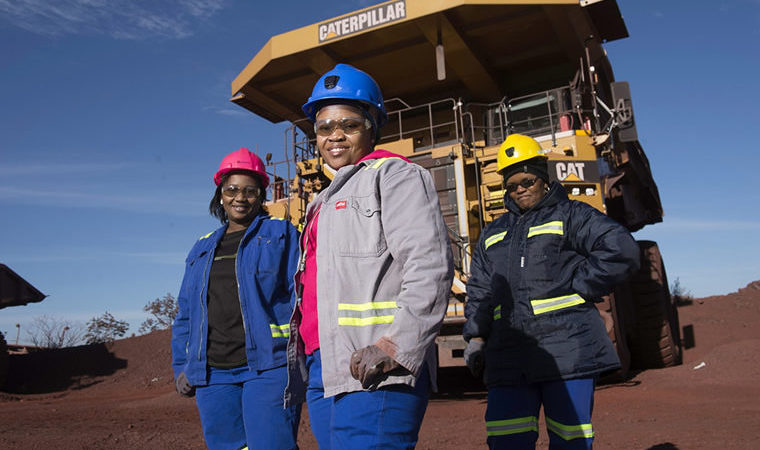
The mining sector continues to grapple with a stark gender imbalance. Women account for just 10–15% of the global mining workforce1, though in some regions and roles, particularly operational and field-based positions, that figure is even lower.
General manager for Martin Engineering’s Africa business, Fran van der Berg.
General manager for Martin Engineering’s Africa business, Fran van der Berg. All images supplied by Martin Engineering
Yet around the world, change is steadily taking root, not only within mining companies, but through the ecosystem of suppliers, contractors and technology providers that underpin the sector. Companies such as global bulk materials handling specialists Martin Engineering are actively working to create more inclusive, opportunity-rich environments to help them develop a more diverse leadership team. Ahead of the International Day of Women in Mining (15 June 2026), two leaders – Fran van der Berg in South Africa and Ashwini Khunte in India – share their insights into how that transformation is taking shape at the company.
From unconventional beginnings
Growing up in South Africa, van der Berg’s route into mining was anything but typical. “I have a degree that falls under the science faculty, but it’s in consumer science,” she explains. “From there, I started working at the university’s marketing department before taking up a marketing executive role for my current company.” Now general manager (GM) for Martin’s Africa business unit, van der Berg oversees a team of more than 100 people and operations across sub-Saharan Africa – regions where mining remains economically vital and globally important.
“Joining the company was a bit of a shock because I’d come from a completely different industry into mining. So everything was new,” she recalls. “I was here about six months and then the marketing manager left. I was thrown in at the deep end!” That early baptism of fire proved formative. “I think what I learned quickly is that I’m good at managing crises,” she adds. Just a few years later, van der Berg was promoted to head of Sales and Marketing for the Europe, Middle East, Africa and India (EMEAI) region before returning to the African business unit as GM.
Across the globe in Pune, India, Ashwini Khunte’s path reflects a more conventional technical entry point, but a no less dynamic progression curve. “I’m a mechanical engineer by training and I joined the company in 2013 as a design engineer in India,” she says. “At that point, we had a small close-knit team and I got lots of hands-on exposure, especially as a new business unit with a huge scope to solve our customers’ material handling problems.”
From drafting and design, Khunte transitioned into project engineering, then product portfolio management. When van der Berg took on the Africa GM role, Khunte stepped up to fill her shoes as head of Sales and Marketing for EMEAI. “It’s been quite a steep learning curve so far,” she reflects. “Each phase has given me something different – technical grounding, customer exposure and now strategic leadership.”
Stepping outside comfort zones
For both women, career progression has been characterised by their capacity and willingness to go beyond familiar territory, plus the opportunities that allowed them to do so. Khunte recalls her initial discomfort when moving into a customer-facing role. “Initially, talking to customers was far out of my comfort zone,” she admits. “But that exposure gave me a good base.” Her technical background became a crucial advantage. “Because I had the engineering knowledge, I could handle technical clarifications and that really built my confidence.”
Today, Khunte’s role requires plotting sales strategy across vastly different markets, from India’s growth-driven demand in sectors like mining, steel and cement, to Europe’s pivot towards circular economy models. “In Europe, the market conditions are very different. We are talking about recycling and waste management,” she explains. “Although the solutions that deliver safety and productive material handling are the same, a completely different mindset is needed.”
Van der Berg echoes the importance and benefits of broad exposure, particularly across diverse cultures. Her move into a regional EMEAI role before returning to Africa proved pivotal. “One of the big learnings for me was how to work with different people,” she says. “You really have to think about how you communicate – asking questions, listening and understanding happen differently in different places.”
Changing cultures from within
While representation matters, both leaders emphasise that bigger change lies in reshaping workplace culture, particularly in traditionally hierarchical environments. “In South Africa, mining is still very traditional,” van der Berg explains. “It is changing, gradually, but some parts of the industry are much slower than others.”
Her leadership approach deliberately challenges those norms. “The big thing for me was moving away from an authoritarian approach, actually listening to people, asking good questions, explaining why and how something needs to happen.” That shift has delivered tangible results. Under her leadership, the company’s Africa business unit has bucked the trend and sustained growth over recent years while diversifying beyond South Africa and reliance on a single historic contract. “My attitude has always been ‘if you know deep down you’re doing the right thing, just keep on doing the right thing and eventually you’ll get that breakthrough,” she says.
In India, Khunte has been part of a similar cultural evolution. “Of course, we still have older ways of thinking in the Indian mining industry,” she says. “But we also have a very dynamic and vibrant young workforce.” With an average team age of around 30, the company’s focus with customers has been on bridging generational and cultural divides. “We are narrowing the gap between old and new ways of working,” she explains. “That’s really important if we want to achieve growth.”
Representation, confidence and reality
Despite their progress, both women are candid about the challenges that persist in the industry, particularly around confidence and visibility. “Many people can experience imposter syndrome,” says van der Berg. “And it’s always easier to try to change yourself to ‘fit in’ rather than trying to change or adjust to the environment.” She believes it’s women themselves who often underestimate their value. “We do have something, a lot, to bring to the performance of the business, and we don’t have to go into a ‘dominant male’ mode to achieve that.”
Instead, she highlights the strengths that women often contribute, such as analytical thinking, attention to detail, relationships and a reflective approach to problem-solving. “There is definitely a space for that in the mining industry, now more than ever,” she says. Yet the reality of walking into a male-dominated customer’s boardroom remains daunting. “Even now, it is sometimes intimidating. But that needs to change,” she says, “and it is changing, one meeting at a time.”
Khunte relates to this experience, referencing the book Lean In by Sheryl Sandberg. “She wrote about not being afraid to sit at the table,” Khunte says. “That really struck me – but to be honest, I still find it hard to do sometimes.” Confidence, she notes, builds over time, but it requires conscious and concerted effort. “If I were to advise others, I’d say just be yourself, and try to sit at the table, literally and figuratively, not on the sidelines,” she says. “Believe in yourself as you have something to offer.”
Practical and empowering
Both leaders emphasise that career-defining moments often come unexpectedly and that the readiness to seize them is key. “Sometimes it only takes one or two moments to pivot your whole career,” van der Berg notes. “Whether that’s something you initiate or an opportunity someone gives you.”
Their advice to women entering mining, indeed any industrial sector, is both practical and empowering. Van der Berg encourages curiosity and self-awareness: “Be inquisitive… understand your power as a woman and what you can bring to an organisation.” She also stresses the importance of visibility and mutual support. “Sometimes women make themselves smaller. We don’t voice all our opinions,” she says. “And we should also give other women opportunities.”
Khunte’s guidance centres on courage and adaptability: “Don’t be afraid. Have confidence in yourself and go and get what is there for you,” she says. “Challenge yourself for sure, go out of your comfort zone.” She firmly believes that growth lies beyond familiarity. “You won’t get exposure by sticking to where you are,” she concluded.
Collective responsibility
The experiences of Ashwini and Fran highlight an important fact: advancing women in mining is not solely about recruitment. It is about retention, development and cultural transformation. Companies in the mining supply chain play a crucial role in this process, putting senior women in front of mine operators, OEMs and EPCs. By fostering inclusive leadership, encouraging cross-functional exposure, and challenging traditional norms, they are helping to reshape the industry from within.
All that said, there is still much progress to be made. Field roles such as service technicians remain heavily male-dominated, and cultural barriers may persist in many regions. But momentum is building. Perhaps most importantly, the narrative is shifting – from one of under-representation to one of opportunity.
As van der Berg reflects: “Enjoy the ride through the ups and the downs, in each period there’s something to learn and rewards to be reaped.” Khunte agrees: “Be yourself, trust in your knowledge and past successes, and take your seat at that table.” More than any other time of year, on International Day for Women in Mining, those words serve not just as advice but as a call to action for an industry in transition.
Articles similaires
Endeavour announces transaction in own shares...
10 sept., 2024 07:27
Ivanhoe Mines Announces MOU with Government of Zam...
10 sept., 2024 12:24
Feasibility Study on Lumwana Super Pit Expansion E...
12 sept., 2024 14:21
Endeavour achieves commercial production at BIOX e...
13 sept., 2024 08:20
Roscan Gold Announces Changes to the Board of Dire...
16 sept., 2024 10:40
Minerals Council pays tribute to Pravin Gordhan...
16 sept., 2024 12:17
Notification of an acquisition of beneficial inter...
18 sept., 2024 08:39
Newmont on track to get at least $2 billion from a...
18 sept., 2024 10:49
UAE firm plans to invest $500m in Tanzania...
19 sept., 2024 08:37