
Autres (mines)

Liberia Moves to Rewrite 2000 Mining Law After $1.6bn Losses


By: OrePulse
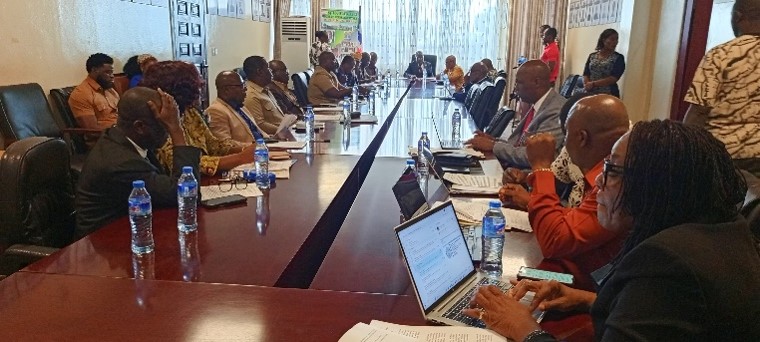
Liberia's House Committee on Lands, Mines, Energy, Natural Resources and Environment has opted to pursue a complete rewrite of the country's 2000 Mining and Minerals Law rather than a set of targeted amendments, citing the scale of illicit and mechanized mining and the environmental damage caused by mercury and cyanide used in gold processing.
The committee's decision followed testimony describing how illegal mining in Liberia has shifted well beyond small-scale, artisanal digging. Col. Abraham Kromah, presenting on behalf of the Protect Our Resources Taskforce, told lawmakers that illegal mining had become "heavily mechanized mining involving excavators, industrial processing equipment and river dredging," rather than the small-scale, hand-tool operations of the past. The task force estimates that Liberia loses roughly $1.6 billion in mineral resources every year to such illegal extraction.
Lawmakers were told that mercury and cyanide used to process gold pose a continuing threat to rivers, forests, aquatic ecosystems and the communities that depend on them, reinforcing the committee's view that the two-decade-old statute needs a ground-up revision rather than incremental fixes.
Sumo Samuel Momolu, assistant minister at the Ministry of Mines and Energy, told the committee that "drafting, validating and completing the legislative process for a new mining law could take approximately one year and six months," at an estimated cost of between $1.5 million and $2 million.
The chairman of Liberia's Law Reform Commission urged lawmakers to fold proposed reforms to the gold sector into the broader rewrite of the mining law, pursued alongside work tied to Liberia's Millennium Challenge Corporation compact, rather than pushing through standalone amendments that could create inconsistencies with the wider legislative overhaul.
Rep. Jeremiah Sokan, who chairs the House committee, said lawmakers are aiming to complete the new law by 2027, with committee hearings on the legislation due to pick back up in October.
The committee's proceedings have not been without friction. Three government bodies, the Environmental Protection Agency, the Ministry of Finance and Development Planning, and the Governance Commission, were threatened with contempt after failing to appear before the committee.
If enacted, a rewritten mining law would reshape licensing, environmental oversight and revenue rules across Liberia's minerals sector, which includes gold mining as well as other mineral resources currently governed by the 2000 statute. For companies operating in the country's formal mining sector, the process carries both risk and opportunity: a modernized legal framework could eventually bring clearer licensing and environmental standards, but with a 2027 target for completion, the existing law is set to remain in force for at least several more years.
Lawmakers have framed the overhaul as a response to a mining sector that has increasingly outgrown the enforcement capacity of a law written a quarter-century ago, as both illicit extraction and its associated environmental damage draw greater scrutiny from Liberian civil society and government auditors alike.
Articles similaires
Rio Tinto approves ~R8.5bn Zulti South investment,...
03 mars, 2026 07:12
Premier African Minerals to receive spodumene flot...
03 mars, 2026 07:35
US struggling to de-risk Congo's 'war zone mineral...
03 mars, 2026 08:03
Nigeria, AFC sign $1.3B deal set to be country's b...
03 mars, 2026 08:07
Can Africa’s mining and natural resources sector a...
03 mars, 2026 08:57
Africa in focus: Downstream value and the critical...
03 mars, 2026 11:02
Africans for Africa (AFA) advances strategic Respo...
03 mars, 2026 12:01
Zimbabwe export ban a temporary dent on lithium su...
04 mars, 2026 09:07
Can Africa’s Mining Reforms Deliver Billions in In...
04 mars, 2026 10:56