
Metal Markets

WPIC: AI, Hydrogen Demand Could Lift Platinum as SA Output Growth Flatlines


By: OrePulse
Global platinum demand is on track to fall 18 percent this year to 7.09 million ounces, according to the World Platinum Investment Council, even as emerging uses in artificial intelligence infrastructure and hydrogen production open new growth avenues for the metal.
The council's latest outlook found investment demand reversing course, moving from net accumulation in 2025 to net disinvestment in 2026, while jewelry fabrication is expected to decline 15 percent to 1.88 million ounces and automotive demand to fall 4 percent to 2.90 million ounces.
Those declines are being partly offset by industrial demand, which the council projects will rise 5 percent to 2.39 million ounces, a rare bright spot in an otherwise softer year for the metal. Within that category, platinum use in glass manufacturing is forecast to climb 23 percent to 98,000 ounces, electrical applications 19 percent to 19,000 ounces, and chemical processing 9 percent to 50,000 ounces.
Edward Sterck, the council's research director, said the rapid buildout of artificial intelligence infrastructure could become a significant new source of demand for platinum, which is used in advanced semiconductors, data center hardware and circuit board manufacturing. He called the trend "potentially quite a tailwind" for the metal, citing China's planned allocation of nearly $300 billion toward AI infrastructure through 2030 and estimated annual private-sector AI spending of $500 billion in the United States.
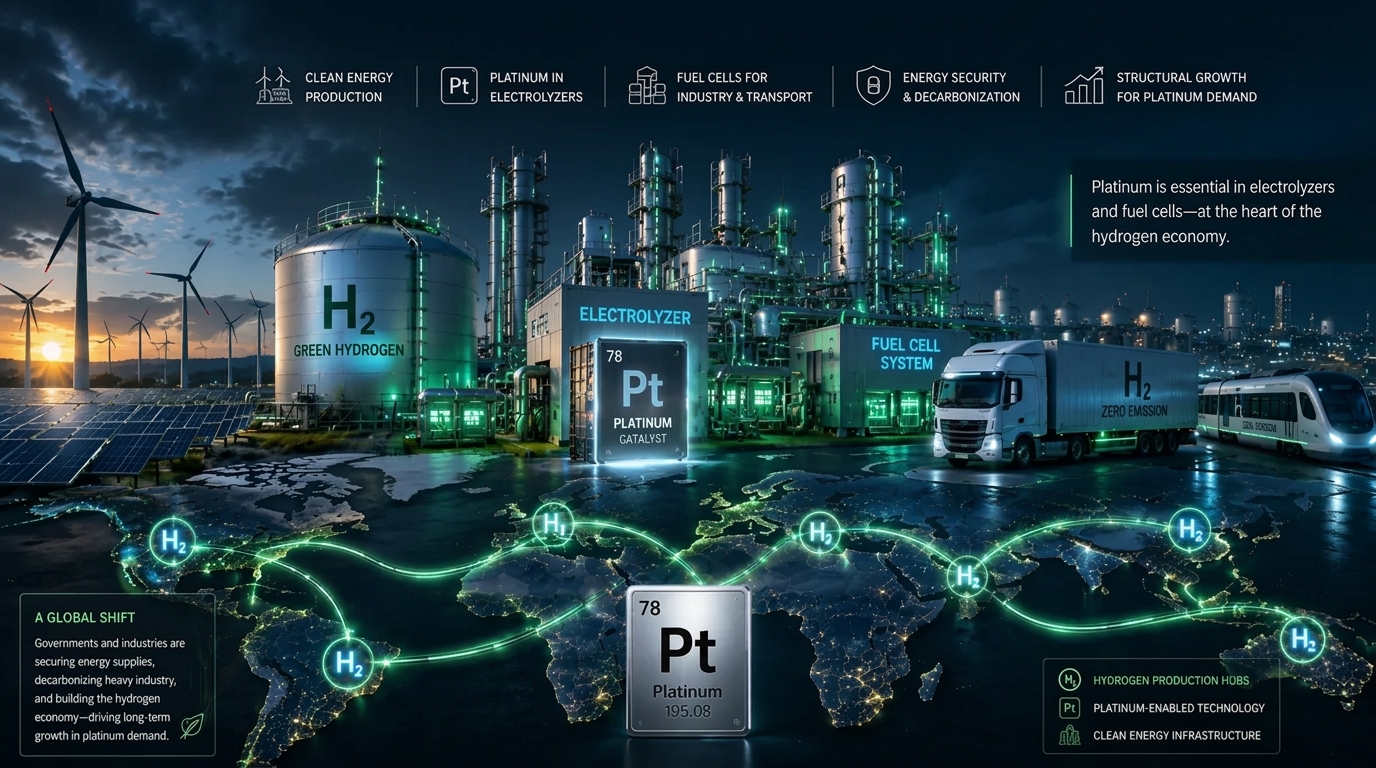
Platinum demand tied to hydrogen applications climbed 72 percent from a year earlier to 19,000 ounces, the council said. Sterck suggested that geopolitical strain over Middle Eastern energy supplies could push governments to expand support for green hydrogen production, comparing the possibility to the development of North Sea oil after the 1970s energy crisis.
The shifting demand picture carries particular weight for South Africa, which supplies about 70 percent of the world's platinum and platinum-group metals from its Bushveld Complex deposits. Output there grew 4 percent year-on-year to 1.08 million ounces in the second quarter, but the council expects second-half production to hold broadly steady, putting full-year growth at just 1 percent.
"From a global perspective, South Africa remains the key supplier of PGMs to the world, and therefore, given that these are critical minerals for most regions around the world, I think the country remains quite key to the availability of those metals," Sterck said.
He added that the new demand drivers hold considerable potential for South Africa given its standing as the world's largest platinum and PGM producer and its Bushveld Complex endowment. With second-half output forecast to remain flat and full-year growth limited to about 1 percent, however, the country's producers appear positioned to benefit only gradually from any pickup in AI- and hydrogen-related demand rather than to expand output quickly to meet it.
Related Articles

Gold prices edge higher to $5,030 as investors wei...
17 Mar, 2026 07:58
Gold prices rise to $5,010 as traders await Fed ra...
18 Mar, 2026 11:47
Spot gold drops over 3 percent to $4,353, its lowe...
23 Mar, 2026 08:35
Silver prices rebound to $69.73 as global markets ...
24 Mar, 2026 08:20
Gold prices extend decline as spot gold drops 0.95...
24 Mar, 2026 08:44
Gold prices surge over 3 percent to $4,558 as weak...
25 Mar, 2026 08:08
Gold prices ease to $4,520.53, silver falls as inv...
26 Mar, 2026 08:33
Gold prices fall to $4,670.2, silver slips as Fed ...
02 Apr, 2026 08:17
UAE gold prices rise to AED563.5 as global markets...
03 Apr, 2026 08:24