Mining Other

Manganese Producers Consortium Backs Phase 3 Rail Reform, Warns Corridors Underprioritized


By: OrePulse
South Africa's Manganese Producers Consortium has welcomed Phase 3 of the Government-Business Partnership for Growth and Jobs, while warning that bulk commodity export corridors remain underprioritized in the country's freight-logistics reform drive.
Phase 3, which took effect August 20, casts freight-logistics reform as a precondition for lifting economic growth above 3% and for reaching the plan's target of one million new jobs by 2030. The consortium said it welcomes a series of hard deadlines built into the plan, including a manganese private-sector-participation transaction to be concluded by the end of 2026, the National Rail Bill going before Parliament by March 2027, and the Transport Economic Regulator becoming fully operational by the same month.
The consortium pointed to early wins already booked under the partnership: 11 private train operators now active in the logistics network, Durban ranked among the world's most-improved ports — though from a low starting point — and R14.7 billion approved through the Budget Facility for Infrastructure to help clear rail maintenance backlogs.
Despite that progress, the consortium said bulk commodity export corridors have not been given adequate priority, even though they suit "globally proven" private-sector-participation models with "significant upside to the South African economy."
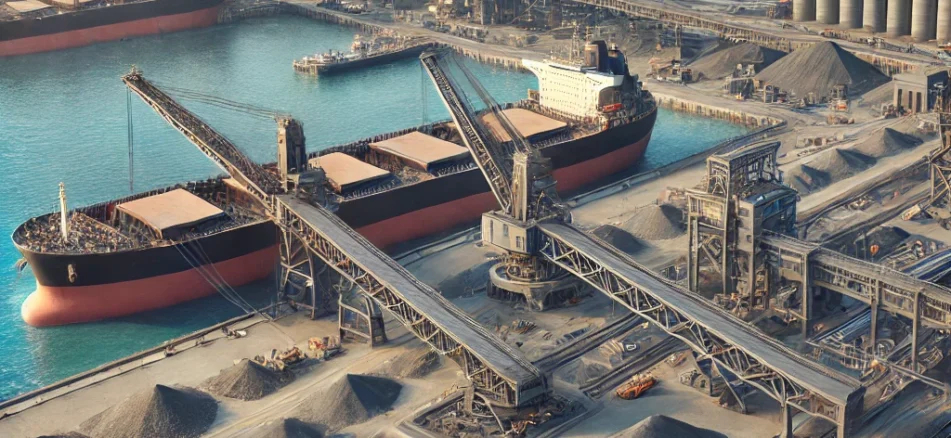
South Africa's Kalahari manganese deposits lie roughly 1,000 km from port, making the sector, in the consortium's words, fundamentally a "mining-plus-logistics business." The consortium said logistics represents roughly a third of manganese production expenses, a burden it argued can only ease through closer public-private cooperation on rail and port capacity.
The consortium is pushing for a "12x12" redistribution of manganese export volumes — 12 million tonnes a year each through the ports of Saldanha and Gqeberha — up from a current split of roughly 8 million tonnes through Saldanha and 16 million tonnes through Gqeberha. It said the Saldanha corridor benefits from minimal competing freight, while Gqeberha's port also handles passenger, automotive and multi-terminal cargo that adds cost and complexity to manganese exports.
The consortium also flagged two long-pending projects for action under Phase 3: a proposed manganese terminal at Port of Ngqura. It expanded private-sector involvement in the Ore Export Corridor, which links Sishen in the Northern Cape to Saldanha's port.
The consortium framed the year-end manganese transaction deadline as "a specific test, with a set deadline, of whether this Phase 3 can convert intent into action." It said the initiative's distinguishing feature compared with earlier plans is a commitment to quarterly public reporting against hard metrics rather than illustrative ones. It added that a single launch event would not judge success, but whether private-sector-participation agreements get signed, more freight volumes shift onto rail, capital gets deployed, and the sector sees a real economic payoff.
Related Articles
Rio Tinto approves ~R8.5bn Zulti South investment,...
03 Mar, 2026 07:12
Premier African Minerals to receive spodumene flot...
03 Mar, 2026 07:35
US struggling to de-risk Congo's 'war zone mineral...
03 Mar, 2026 08:03
Nigeria, AFC sign $1.3B deal set to be country's b...
03 Mar, 2026 08:07
Can Africa’s mining and natural resources sector a...
03 Mar, 2026 08:57
Africa in focus: Downstream value and the critical...
03 Mar, 2026 11:02
Africans for Africa (AFA) advances strategic Respo...
03 Mar, 2026 12:01
Zimbabwe export ban a temporary dent on lithium su...
04 Mar, 2026 09:07
Can Africa’s Mining Reforms Deliver Billions in In...
04 Mar, 2026 10:56