Metal Markets

Global De-Dollarization Trend Drives Gold Market Revolution in 2025


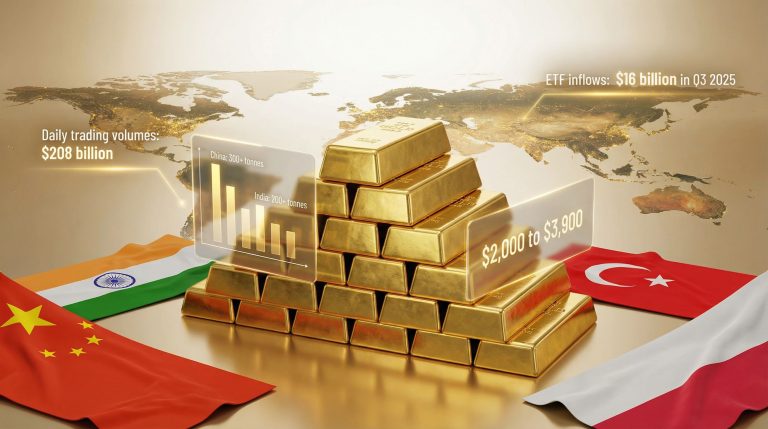
The modern global financial architecture is experiencing significant pressure as traditional monetary frameworks face systemic challenges. A combination of mounting sovereign debt, persistent inflation, and geopolitical fragmentation has created conditions conducive to a monetary regime transition. A central feature of this shift is the de-dollarization trend within gold markets, a significant force reshaping how nations approach monetary sovereignty and reserve management. These are structural forces operating independently of short-term cycles, representing fundamental changes in international reserve management, trade, and monetary policy.
Central banking institutions worldwide are reassessing their reserve allocation strategies, moving beyond the frameworks established after the collapse of the Bretton Woods system. This institutional repositioning reflects deeper concerns about the risks of currency concentration and the long-term sustainability of dollar-dominated systems. The implications extend far beyond foreign exchange, creating ripple effects across commodity markets and global trade settlement mechanisms.
De-dollarization represents a systematic, institutional reduction in reliance on the US dollar for trade, reserves, and financial transactions. This process, which accelerated after 2022, encompasses reserve diversification, the development of alternative payment systems, and the restructuring of bilateral trade agreements. Historical context traces back to 1971, when the suspension of dollar-gold convertibility established the dollar's dominance through inertia and network effects—a position now under increasing scrutiny.
Gold has re-emerged as a critical monetary anchor due to its unique characteristics: it carries no counterparty risk, is unaffected by any single nation's policies, and boasts millennia of precedent as a store of value. Its high liquidity facilitates large institutional transactions, while its physical nature allows for storage in neutral jurisdictions, providing a geographical diversification that digital assets cannot match. This tangible quality becomes increasingly valuable in a fragmenting financial world.
Asian economic powers are at the forefront of this diversification. The People's Bank of China has conducted steady, large-scale gold purchases alongside developing alternative payment systems. Similarly, the Reserve Bank of India has increased gold holdings as a hedge against inflation and currency volatility, reflecting both cultural affinity and strategic portfolio management. Other nations like Turkey and Poland have also aggressively accumulated gold, driven by currency instability and geopolitical security concerns.
This institutional demand has fundamentally transformed the gold market. Central bank purchasing created a stable, non-volatile price appreciation from 2022 into 2024. The subsequent entry of retail and speculative investors, attracted by lower interest rates and persistent inflation, introduced greater volatility but sustained the underlying upward trend. This shift represents a structural change in global monetary architecture, with central banks treating gold as strategic infrastructure rather than a speculative asset.
Historical precedents, such as the 1979-1980 gold surge, provide a framework for understanding the current cycle's potential scale. Mathematical projections based on similar percentage gains suggest that significant further appreciation is plausible, though the timeline depends on the pace of institutional change—from rapid shifts driven by coordinated policy to slow, generational evolution.
Ultimately, the movement is underpinned by unprecedented global debt levels and the fragmentation of payment systems, which increase demand for neutral settlement assets. While this environment presents significant opportunities in precious metals and related assets, it also carries risks including potential policy responses, interest rate changes, and market volatility, necessitating careful portfolio construction and risk management.
Related Articles

Saudi Arabia champions global partnerships to powe...
21 Oct, 2025 06:51
Can Turkey Become a Rare Earth Element Power?...
23 Oct, 2025 13:24
Orion Minerals Set to Develop Secure, Responsible,...
23 Oct, 2025 14:12
Investing in Platinum Stocks...
24 Oct, 2025 06:56
Copper And Aluminum Prices Climb As Supply Worries...
24 Oct, 2025 07:09
Dubai 24-carat gold prices dip AED3.75 as global r...
24 Oct, 2025 12:06
Bauxite sales up but tariffs on Chinese metal ship...
27 Oct, 2025 13:15
Angola bids for majority stake in De Beers, source...
28 Oct, 2025 07:02
Dubai 24-carat gold price today drops AED479; glob...
28 Oct, 2025 08:15