Autres (mines)

Bab el-Mandeb Disruption Threatens Up to $2.5B in Mining Supply Chain Costs


By: OrePulse
A sustained disruption at the Bab el-Mandeb Strait could put between 38.9 million and 77.8 million tonnes of commodities and materials critical to the global mining industry at risk over a 90-day window, with associated cost increases ranging from $480 million to as much as $2.48 billion, according to research published by GEM Mining Consulting.
In its central scenario, the consultancy projects affected trade volumes of roughly 61.1 million tonnes, alongside cost premiums totaling $1.37 billion — figures that translate into value-weighted price pressures of between 1.2% and 10.5%, depending on how severe and prolonged the disruption turns out to be.
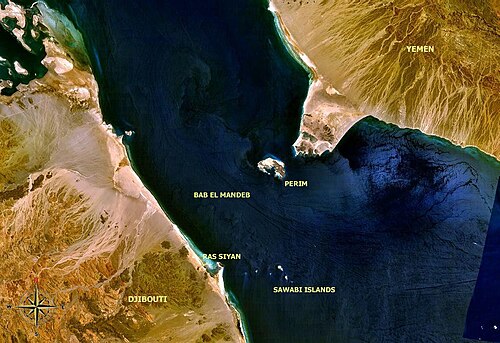
The Bab el-Mandeb Strait, a narrow waterway separating the Arabian Peninsula from Africa, connects the Red Sea to the Gulf of Aden and handles about 10% of the world's maritime trade, serving as a vital link between markets in Asia, the Middle East and Europe via the Suez Canal. Control over this corridor has increasingly slipped into the hands of Yemen's Iran-backed Houthi forces, who have taken the Greater and Lesser Hanish islands in addition to their earlier seizures of Mokha port and Perim Island.
Much of the public focus on Red Sea disruptions to date has centered on oil markets. Still, GEM's research indicates the risks extend far beyond energy alone, reaching deep into the materials mining operations depend on throughout their supply chains. Among the inputs flagged as especially exposed are sulfuric acid, ammonia, nitrate-based products, phosphate and potash fertilizers, graphite, battery materials, petroleum products and liquefied natural gas — commodities that mining and processing operations rely on for everything from chemical reagents and explosives production to downstream material inputs.
According to the analysis, the biggest danger facing mining companies isn't outright shortages of minerals themselves, but rather a combination of rising freight costs, higher insurance premiums, extended shipping times and greater working-capital demands. Vessels forced to reroute around the southern tip of Africa to avoid the strait face considerably longer voyages, which in turn drives up costs at every stage of the supply chain.
GEM Mining Consulting advised companies to map their critical shipping routes and pressure-test inventory buffers against disruption scenarios spanning 30, 90 and 180 days, while also building relationships with backup suppliers to reduce dependence on this corridor. The consultancy also called on governments in the region to improve trade transparency and coordinate maritime security efforts.
These findings add to a growing body of research showing how instability in a single, narrow shipping corridor can send shockwaves through global industrial supply chains—touching everything from fertilizer and explosives inputs used at mine sites to the battery materials that underpin the broader energy transition. With no clear signs that Houthi control over the corridor will loosen anytime soon, the analysis suggests mining companies and their suppliers are facing an ongoing, rather than temporary, source of cost and scheduling risk tied to Red Sea shipping routes.
Articles similaires

Endeavour announces transaction in own shares...
10 sept., 2024 07:27
Ivanhoe Mines Announces MOU with Government of Zam...
10 sept., 2024 12:24
Feasibility Study on Lumwana Super Pit Expansion E...
12 sept., 2024 14:21
Endeavour achieves commercial production at BIOX e...
13 sept., 2024 08:20
Roscan Gold Announces Changes to the Board of Dire...
16 sept., 2024 10:40
Minerals Council pays tribute to Pravin Gordhan...
16 sept., 2024 12:17
Notification of an acquisition of beneficial inter...
18 sept., 2024 08:39
Newmont on track to get at least $2 billion from a...
18 sept., 2024 10:49
UAE firm plans to invest $500m in Tanzania...
19 sept., 2024 08:37