Base Metals

Ivanhoe reports 71 417 t of copper from Kamoa-Kakula, record 6% increase in production from Kipushi



The company notes that the total consisted of 63 671 t of copper in anode produced by Kamoa-Kakula’s on-site, direct-to-blister copper smelter and 7 746 t of copper in blister produced by the Lualaba Copper Smelter (LCS), in Kolwezi.
In addition, Kamoa-Kakula’s on-site copper smelter produced 117 871 t of high-strength sulphuric acid during the quarter.
On March 31, Ivanhoe Mines announced the results of an updated technical report for the Kamoa-Kakula Copper Complex.
Ivanhoe says the updated mineral reserve estimate (MRE) comprises 466-million tonnes of ore at a grade of 2.82% copper, containing 13.1-million tonnes of copper.
The company explains that the estimate incorporates changes to the mine design and extraction sequence, taking into consideration cautious geotechnical parameters based on analysis by world-leading experts.
The technical report also outlined an updated mine plan and production schedule.
Under the Kamoa-Kakula MRE, Ivanhoe says the phase 1, 2 and 3 concentrators will ramp up to a combined steady-state rate of 17-million tonnes a year over an about 25-year life-of-mine.
In addition, revised copper production guidance outlined the ramp-up to over 500 000 t/y of copper from 2028 onwards.
Meanwhile, Ivanhoe reports that the Kipushi concentrator, also in the DRC, delivered another record quarter, milling a record 196 774 t of ore at an average grade of 36.96%, producing a record 65 044 t of zinc in concentrate.
The record quarterly production represented a 6% increase compared to quarter four of 2025. In addition, for the first time concentrator recoveries averaged over 90% during the quarter.
Meanwhile, the 800 000 t/y Phase 1 concentrator at Ivanhoe's Platreef platinum group metal and base metals mine, in South Africa, was campaigned during the quarter with lower-grade development ore, ahead of completion of Shaft #3.
Ivanhoe says Shaft #3 will increase the mine’s hoisting capacity by about five times, enabling the concurrent hoisting of ore and development waste, which was previously not possible with Shaft #1 alone.
The company notes that construction of Shaft #3, as well as its associated underground materials-handling and crushing plants, was completed on schedule in late March and is currently undergoing commissioning.
Once Shaft #3 ramps up in the coming weeks, Ivanhoe says the Phase 1 concentrator will be continuously fed with higher-grade production ore.
In addition, Shaft #3 will also hoist waste development required in preparation for the Phase 2 expansion, which is on schedule to be completed by the end of 2027.
Early works on the Phase 2 expansion’s surface infrastructure also started during the first quarter. The breaking of ground on the 3.3-million-tonne-a-year Phase 2 concentrator site is expected to begin imminently.
Ivanhoe founder and co-chairperson Robert Friedland says that the company is expecting that the continued closure of the Strait of Hormuz will have a profound effect on global supply chains.
Therefore, he says, contingency plans have been drawn up across Ivanhoe’s operating sites to sustain its operations, including advanced diesel purchases.
“Our mine-site managers are prudent and optimistic that we are well-positioned,” he says.
“If the closure of the Strait of Hormuz continues, we are especially concerned about the availability of precursor materials necessary for the mining industry to continue operating,” he adds.
Friedland says a second-derivative effect will be on global copper production owing to the shortage of the world's most important industrial chemical, sulphuric acid.
He notes that about 20% of global copper supply relies on a process that uses sulphuric acid to leach copper from oxide ores.
“With about 50% of the global seaborne sulphur supply cut off, sulphur and sulphuric acid markets are becoming extremely tight,” he says.
Against this backdrop, Friedland assures that Kamoa-Kakula is ideally positioned as a producer and seller, and therefore not a consumer, of sulphuric acid.
“Our on-site copper smelter produces high-strength sulphuric acid as a by-product, which we sell to oxide copper mining operations in the DRC Copperbelt.
“To be clear, our industrial process does not require sulphuric acid to produce 99.7%-pure copper anodes.
“In addition, we have refurbished over 250 MW of hydroelectric capacity in the DRC that powers our operations . . . and soon we will have an additional 60 MW of power from our new solar field with battery storage.”
Friedland adds that Kamoa-Kakula has a very low rate of diesel consumption per tonne of copper produced, further strengthening the strategic advantage of the company’s integrated operations.
He says the Platreef mine’s Phase 2 expansion is advancing on schedule, describing the recent completion of Shaft #3 as a major milestone that dramatically accelerates the project.
“At Kipushi, we’ve delivered yet another record-breaking quarter, mining the highest-grade zinc in the world. With further improvements made to the management of grid and back-up power, further throughput gains are to come.”
Ivanhoe will report its financial results for the first quarter and a detailed update on its operations after market close on May 6.
Related Articles
Guinea weighs bauxite export quotas as prices slid...
17 Mar, 2026 07:31
Cobalt shortages driven by Congo curbs seen lastin...
18 Mar, 2026 12:31
Orion to pay final R14.74m for a controlling inter...
19 Mar, 2026 08:39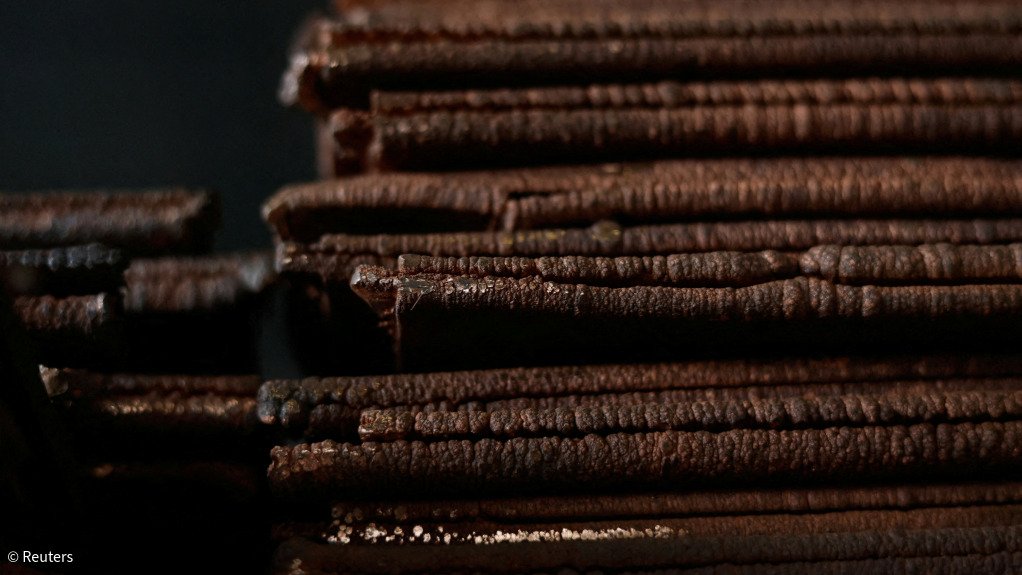
KoBold Metals targets early-2030s copper output at...
19 Mar, 2026 08:44
Algeria begins construction of Oued Amizour zinc-l...
19 Mar, 2026 11:04
Bahrain’s Alba shuts 19% of aluminum capacity as H...
19 Mar, 2026 11:42
Botswana Minerals to raise £1.15m, makes board cha...
23 Mar, 2026 12:27
Jubilee reports delay in Molefe Phase 1 drilling r...
24 Mar, 2026 13:09
Rio Tinto expects Resolution Copper mine to open b...
25 Mar, 2026 08:48