Mining Other

Australian Uranium and the Middle East's Nuclear Ambitions


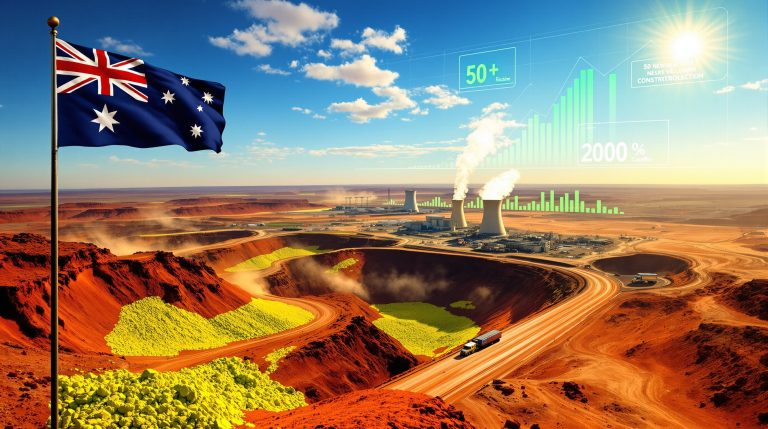
Australia holds approximately one-third of the world’s proven uranium reserves, establishing the nation as a strategic participant in the global nuclear fuel supply chain The Australian Securities Exchange provides diverse exposure to the sector through companies ranging from established producers to emerging exploration ventures, despite regulatory restrictions in certain jurisdictions
The sector is geographically diversified across multiple states, with South Australia hosting significant production facilities and the Northern Territory containing world-class deposits This provides investors with varied exposure to different geological settings and regulatory environments within the Australian uranium investment landscape
Global nuclear capacity expansion continues to accelerate, with over 50 reactors currently under construction worldwide This development pipeline creates sustained uranium demand that existing production capacity struggles to meet, particularly as primary mining output fails to satisfy annual consumption requirements Energy security concerns have intensified following geopolitical disruptions, prompting nations to prioritise domestic nuclear capabilities and secure long-term fuel supply arrangements
| Region | Planned Capacity (GW) | Additional Annual Uranium Demand (tonnes) |
|---|---|---|
| China | 70+ | 12,000-15,000 |
| India | 25+ | 4,500-6,000 |
| Southeast Asia | 15+ | 2,500-3,500 |
| Middle East | 20+ | 3,500-4,500 |
Successful uranium stock analysis requires understanding multiple operational and financial factors that distinguish viable projects from speculative ventures Resource quality often matters more than total tonnage, with higher-grade deposits providing superior economics and reduced environmental impact Critical assessment criteria include resource base quality, development timeline, geographic risk, technical expertise, and financial position
Among premier ASX investment options, Boss Energy has successfully restarted production at its Honeymoon project in South Australia, while Paladin Energy has established itself as a globally significant producer with its Langer Heinrich Mine in Namibia Deep Yellow has systematically assembled a commanding position in Namibia’s uranium sector, and Energy Resources of Australia maintains significant processing capabilities despite the cessation of mining at its historic Ranger operation
Australia’s bilateral nuclear cooperation agreements with major consuming nations provide secure market access while maintaining strict non-proliferation standards The nation’s political stability and established nuclear safeguards framework position top ASX uranium stocks favourably for utility contract negotiations, particularly as global supply-demand fundamentals continue to strengthen amid growing recognition of nuclear power’s role in clean energy transitions
Related Articles
Endeavour announces transaction in own shares...
10 Sep, 2024 07:27
Ivanhoe Mines Announces MOU with Government of Zam...
10 Sep, 2024 12:24
Feasibility Study on Lumwana Super Pit Expansion E...
12 Sep, 2024 14:21
Endeavour achieves commercial production at BIOX e...
13 Sep, 2024 08:20
Roscan Gold Announces Changes to the Board of Dire...
16 Sep, 2024 10:40
Minerals Council pays tribute to Pravin Gordhan...
16 Sep, 2024 12:17
Notification of an acquisition of beneficial inter...
18 Sep, 2024 08:39
Newmont on track to get at least $2 billion from a...
18 Sep, 2024 10:49
UAE firm plans to invest $500m in Tanzania...
19 Sep, 2024 08:37