Autres (mines)

Trump-linked GreenMet CEO Drew Horn targets Nigeria and Cameroon for critical minerals deals


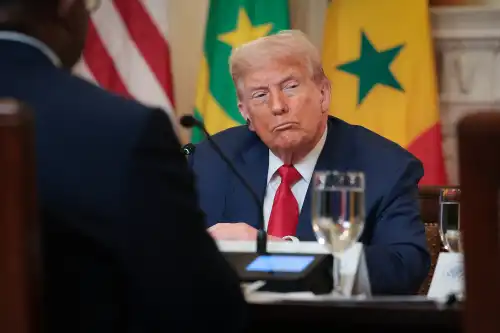
Drew Horn, the founder and chief executive of GreenMet and a former national security official in the Trump administration, is targeting Nigeria and Cameroon for critical minerals investment as Washington accelerates its push to secure African resources and reduce dependence on Chinese-dominated supply chains, Africa Intelligence reported Tuesday.
Horn is eyeing meetings in Abuja and Yaoundé as part of a geographic expansion of GreenMet's ambitions beyond Greenland, where the Washington-based critical minerals company has been the most prominently Trump-connected private operator since early 2026, according to the report by the Paris-based intelligence publication.
GreenMet, formerly known as Greentech Minerals Holdings, was founded in 2021 and raised $50 million in private equity funding from Cerberus Capital Management and Libra Group. Horn, who served as policy director for then-Vice President Mike Pence and subsequently as senior adviser to the Director of National Intelligence during the first Trump administration, has described the company's mission as building secure critical minerals supply chains to serve US national security needs.
The company attracted significant attention in January 2026 when OCCRP and NPR investigations revealed that George Sorial, the former executive vice president and chief compliance counsel of the Trump Organization, and Keith Schiller, Trump's longtime bodyguard and former director of security at the Trump Organization, were listed as beneficial shareholders in GreenMet. Both men described themselves as passive minority investors with no management role. Horn has been the company's public face and operational decision-maker throughout.
Nigeria and Cameroon represent very different mineral propositions. Nigeria holds significant deposits of lithium, gold, iron ore, lead, zinc, coal and a range of industrial minerals across its Middle Belt and northern states. The country's solid minerals sector has been a priority for the Tinubu administration, with Dele Alake, the minister of solid minerals development, pursuing an aggressive foreign investment campaign that has attracted interest from the United States, China, Australia and the Gulf states. The US sent its largest-ever official delegation to the Investing in African Mining Indaba in Cape Town in February 2026, a deliberate signal of Washington's renewed engagement with African resource politics.
Cameroon's mineral attraction is more specific. The US acting chargé d'affaires in Yaoundé met Cameroon's acting minister of mines in March 2026, flagging American interest in the country's cobalt, nickel, manganese, rutile and scandium deposits. Washington linked stronger investment to an improved business climate and regulatory clarity — standard conditions for a country that has historically struggled to translate its mineral endowment into operating mines. Australia's high commissioner attended the same meeting, reflecting the allied nations' coordinated approach to mineral security.
The broader context for Horn's West African moves is Washington's intensifying competition with Beijing for African mineral influence. China has invested over $700 billion across 49 African nations since launching the Belt and Road Initiative, with Nigeria, Egypt, Kenya, Ethiopia and Angola among the largest borrowers. Chinese state-backed entities control significant positions in cobalt, lithium, manganese and other battery minerals across the Democratic Republic of Congo, Zimbabwe and Zambia. The Trump administration's mineral diplomacy in Africa, of which Horn and GreenMet are the most commercially visible private sector expression, is explicitly framed as a counter to that dominance.
GreenMet has not published a press release confirming the Nigeria and Cameroon visits reported by Africa Intelligence. Horn did not respond to requests for comment as of publication time. The company's most recent public communications focused on its Greenland engagement, including a May 2025 strategic visit to Nuuk and Copenhagen that Horn described as advancing US-Greenland collaboration in critical minerals. That visit came after the Trump administration secured $120 million in US Export-Import Bank support for the Tanbreez rare earths project in Greenland, in which GreenMet holds interests.
Whether the Nigeria and Cameroon moves will result in formal investment agreements, joint ventures with Nigerian or Cameroonian state entities, or bilateral memoranda of understanding with the two governments remains to be seen. What the Africa Intelligence report signals is that the Trump-connected frontier minerals push, which has so far been most visible in Greenland, the Democratic Republic of Congo and other priority African jurisdictions, is extending its geographic ambition into West Africa's largest economy and one of Central Africa's most mineral-rich but investment-challenged markets.
Articles similaires
Endeavour announces transaction in own shares...
10 sept., 2024 07:27
Ivanhoe Mines Announces MOU with Government of Zam...
10 sept., 2024 12:24
Feasibility Study on Lumwana Super Pit Expansion E...
12 sept., 2024 14:21
Endeavour achieves commercial production at BIOX e...
13 sept., 2024 08:20
Roscan Gold Announces Changes to the Board of Dire...
16 sept., 2024 10:40
Minerals Council pays tribute to Pravin Gordhan...
16 sept., 2024 12:17
Notification of an acquisition of beneficial inter...
18 sept., 2024 08:39
Newmont on track to get at least $2 billion from a...
18 sept., 2024 10:49
UAE firm plans to invest $500m in Tanzania...
19 sept., 2024 08:37