Autres (mines)

Mining sector contributes GH¢22.2bn despite global headwinds


By: Business & Financial Times Online
The large-scale mining sector contributed more than GH¢22.22billion to the economy in 2025, defying a challenging global environment marked by geopolitical tensions, inflationary pressures, supply chain disruptions, energy market volatility and growing climate-related obligations.
The mining industry’s strong showing comes at a time when governments, investors and civil society groups are increasingly questioning whether resource-rich countries are receiving a fair share of the benefits from rising commodity prices.
Against that backdrop, the Ghana Chamber of Mines and Ghana Extractive Industries Transparency Initiative (GHEITI) have agreed to undertake a comprehensive assessment of the country’s effective tax take from major mining concessions in a move that could influence future debates on mining revenues, fiscal terms and resource ownership.Ghana Economic Forum
Addressing the Ghana Chamber of Mines’ 98th annual general meeting (AGM), Chief Executive Officer of the Chamber Dr. Kenneth Ashigbey said the sector remains a major pillar of the economy despite mounting global and domestic pressures.
Beyond revenue generation, he said, the industry supported 13,819 direct jobs, spent about US$4.2billion on local procurement and invested US$88.6million in community development initiatives during the year under review.
“It also sustained merchandise exports, foreign exchange generation through the Domestic Gold Purchase Programme, infrastructure investment and community development,” Dr. Ashigbey said.
The industry’s performance comes amid growing calls across Africa for greater value retention from mineral resources and stronger local participation in extractive industries.
Rising gold prices have intensified public scrutiny of the benefits accruing to host countries, with questions increasingly being raised about whether existing fiscal arrangements provide an equitable return to resource owners.
It is against this backdrop that the Chamber and GHEITI are seeking to establish a clearer picture of the actual share of mining proceeds retained by the state compared with earnings accruing to mining companies.
The assessment, disclosed during the AGM, is expected to compare government’s take from major mining concessions against company returns and provide empirical evidence to inform a debate that has gained prominence in recent years.
Speaking in a solidarity message at the event, Co-Chair of the GHEITI Multi-Stakeholder Group Dr. Steve Manteaw said the initiative is aimed at addressing misconceptions surrounding the distribution of benefits from Ghana’s mining industry.Ghana Economic Forum
“I am glad the Chamber has accepted GHEITI’s proposal to assess the effective tax rates for major mining concessions in Ghana to establish the ‘Government Take’ versus ‘Company Take’,” he said.
According to Dr. Manteaw, the exercise is expected to help address what he described as the entrenched but misleading narrative that Ghana receives only about five percent of the benefits generated from mining activities.
He noted that soaring gold prices have brought renewed attention to questions of benefit-sharing and resource ownership, contributing to policy shifts and rising resource nationalism in several African mining jurisdictions.
“The times indeed call for introspection and a carefully thought-through strategy to court public understanding of industry realities, explore new ways of value sharing and adopt a more proactive engagement to address emerging concerns,” he said.
Dr. Ashigbey meanwhile said fiscal policy advocacy remained one of the Chamber’s key priorities during the year, particularly as mining companies grappled with rising operating costs and increased fiscal pressures.
He noted that the Growth and Sustainability Levy (GSL) increase from 1 percent to 3 percent has generated concerns within the industry regarding investment competitiveness and long-term planning.
“Policy stability is vital for competitiveness, investment and long-term planning. Through ongoing, evidence-based engagement with government and stakeholders, we secured a reduction in the GSL to 1 percent in 2026 and a commitment to phase it out by 2028,” he said.
Dr. Ashigbey also indicated that the Chamber will continue to advocate eventual removal of the levy altogether, arguing that a stable and predictable fiscal regime remains critical to attracting long-term investment.
The Chamber, he mentioned, also participated in ongoing reviews of the Minerals and Mining Act – advocating reforms in areas including lease administration, stability agreements and dispute resolution mechanisms.
According to Dr. Ashigbey, the industry supports introducing a medium-scale mining category and establishing timelines for the ratification of mining leases. It also backed conditional reinstatement of international arbitration provisions to strengthen investor confidence while safeguarding national interests.
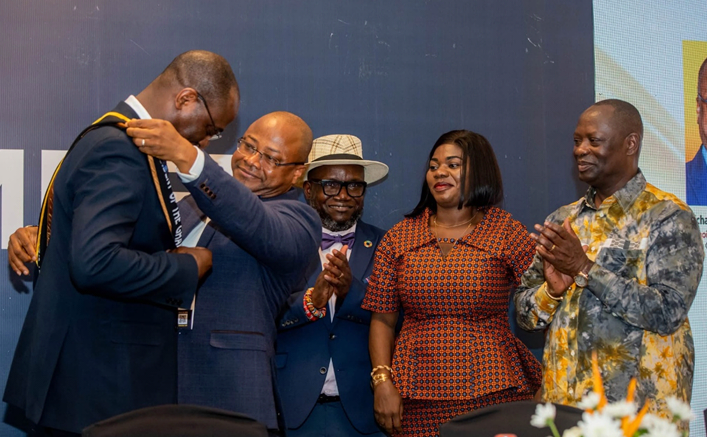
The AGM, which was held under the theme ‘How Can Responsible Mining and Power Accelerate West Africa’s Sustainable Development?’, brought together policymakers, mining executives, regulators and development partners to discuss the sector’s future.
Speaking at the event, Minister for Lands and Natural Resources Emmanuel Armah-Kofi Buah said government recognises mining as a strategic pillar of economic growth and a major source of foreign exchange earnings.
“Within our medium-term development framework, the sector has been prioritised as part of our broader agenda to stabilise the economy, promote industrialisation and strengthen resilience against global shocks,” he said.
The minister noted that government is pursuing reforms aimed at improving regulatory certainty and operational efficiency, including the ongoing digitalisation of mineral licencing and permitting processes.
He said the measures are expected to reduce delays, improve transparency and enhance investor confidence.
“These reforms are critical to positioning Ghana as a competitive and predictable mining destination within the West Africa region,” Mr. Buah added.
Articles similaires
Endeavour announces transaction in own shares...
10 sept., 2024 07:27
Ivanhoe Mines Announces MOU with Government of Zam...
10 sept., 2024 12:24
Feasibility Study on Lumwana Super Pit Expansion E...
12 sept., 2024 14:21
Endeavour achieves commercial production at BIOX e...
13 sept., 2024 08:20
Roscan Gold Announces Changes to the Board of Dire...
16 sept., 2024 10:40
Minerals Council pays tribute to Pravin Gordhan...
16 sept., 2024 12:17
Notification of an acquisition of beneficial inter...
18 sept., 2024 08:39
Newmont on track to get at least $2 billion from a...
18 sept., 2024 10:49
UAE firm plans to invest $500m in Tanzania...
19 sept., 2024 08:37