Autres (mines)

Gabon and Guinea Push Iron Ambitions Despite Price Woes


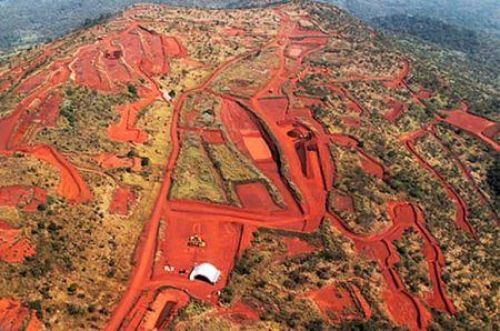
The World Bank’s April 2025 “Commodity Markets Outlook” predicts iron ore will drop to $95 a tonne in 2025 and $88 in 2026, down from $120 in 2023. The World Bank blames China’s weak property sector, sluggish industry, and rising supply from Australia, Brazil, and Guinea for the decline.
Guinea moves ahead with the Simandou project, a mining giant that could raise the country’s real GDP by 26% by 2030, according to the International Monetary Fund (IMF). Even if iron ore prices drop 15%, the IMF says Simandou will still deliver a big economic boost. The Guinean government expects Simandou to produce 60 million tonnes in 2026 and 120 million tonnes in 2027. The country sees long-term rewards and keeps investing, despite today’s tough market.
Gabon also stays the course; it wants to diversify mining beyond manganese, which made up 40% of exports in 2022 and dominates the sector, contributing 6% of GDP. Gabon bets on iron to broaden its mining base.
Australia’s Genmin signed a mining deal with Gabon in March 2025 for the Baniaka project. Genmin plans to start production in 2026, after taking time to secure financing. Genmin has already signed agreements with Chinese steelmakers to buy future output, possibly including loans or prepayments.
Still, risks loom. BMI forecasts iron ore will slide to $78 a tonne by 2033. Lower prices could slash government tax revenue and squeeze mining company profits. Brazil’s Vale, a global leader, saw its EBITDA drop 22% in 2024 to $15.4 billion, with a 40% profit fall in the fourth quarter alone. As new African mines enter the market, their profitability faces more pressure.
Africa already has iron ore producers–Mauritania, Liberia, and South Africa–feeling the pinch from changing prices and oversupply.
Articles similaires
Endeavour announces transaction in own shares...
10 sept., 2024 07:27
Ivanhoe Mines Announces MOU with Government of Zam...
10 sept., 2024 12:24
Feasibility Study on Lumwana Super Pit Expansion E...
12 sept., 2024 14:21
Endeavour achieves commercial production at BIOX e...
13 sept., 2024 08:20
Roscan Gold Announces Changes to the Board of Dire...
16 sept., 2024 10:40
Minerals Council pays tribute to Pravin Gordhan...
16 sept., 2024 12:17
Notification of an acquisition of beneficial inter...
18 sept., 2024 08:39
Newmont on track to get at least $2 billion from a...
18 sept., 2024 10:49
UAE firm plans to invest $500m in Tanzania...
19 sept., 2024 08:37