Mining Other

Saudi Arabia turns conference into global mining cause


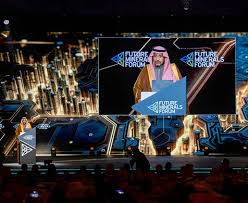
The Future Minerals Forum (FMF) has reached a point few industry gatherings ever achieve – it’s no longer measured by delegate numbers alone, but by momentum.
Walking the halls at the King Abdulaziz International Conference Center in Riyadh throughout, Saudi Arabia’s Deputy Minister of Mining, Khalid Al-Belushi, sums it up succinctly. FMF, he says, is “becoming more of a cause rather than just a conference or an exhibition”.
Speaking on the sidelines of the event, the Minister tells Mining.com.au that with an estimated 40,000 participants this year, FMF has evolved into a convening force that pulls together the entire mining ecosystem – from grassroots explorers and service providers through to tier-one miners, financiers, traders, and policymakers — at a moment when the global minerals sector is under intense pressure to move faster, discover more, and operate more transparently.
“We really enjoy being at the Future Minerals Forum. It’s becoming more of a cause rather than just a conference or an exhibition. Today, as you walk around the exhibition or walk around the holes of the Future Minerals Forum, you realise that now we’re becoming experts in crowd management rather than only investment attraction or moving talk into action,” he tells this news service
“It’s been a pleasure to meet all these countries being represented by their ministers, talking to a whole suite of mining companies. Talk to the mid-caps, you talk to the tier one miners, We talk to the exploration-focused companies, service providers.
“And today we have bankers, we have financiers, traders, and we have lots of lawyers as well. And so the full ecosystem mining is convening to make sure that they put the right policies and the right objectives for the entire mineral sector, not only for Saudi Arabia, but globally.”
As Mining.com.au shows throughout its rolling coverage of the event, there is consensus that global collaboration in mining is no longer optional but an urgent necessity.
The Saudi Government used the fifth Ministerial Roundtable at FMF to reiterate its focus on ensuring local value is maximised across multiple industries that will aid in long lasting value.
For Saudi Arabia, FMF is not an accessory to reform. It is the public-facing engine of a mining strategy that is already reshaping how the Kingdom is perceived as a destination for exploration capital.
From Vision to reality
Saudi Arabia’s mining transformation did not begin with FMF, but the forum has become one of the most visible and tangible aspects of the Kingdom’s Vision 2030.
The Kingdom’s mining and minerals strategy was approved in December 2017 under the direction of Crown Prince Mohammed bin Salman, with execution placed squarely under the Ministry of Industry and Mineral Resources. The plan was ambitious, mapping targets and objectives through to 2030 at a time when Saudi Arabia ranked near the bottom of global mining investment attractiveness.
That position has changed dramatically. According to Al-Belushi, Saudi Arabia has climbed from 104th to 24th place on the Fraser Institute’s investment attractiveness index by 2024 — a leap that reflects not marketing, but structural change.
“This took a lot of transformation and a lot of effort into availing more geological data. We’ve run our regional geosciences program. We’ve covered the entire Arabian field with geophysical survey, geochemical survey, with the support of our international partners. We’ve made the data available and we’re done with the entire phase one of a regional geo-sciences program and its data,” the Minister explains to Mining.com.au.
“This took a lot of transformation and a lot of effort into availing more geological data”
“Today, we’re contracting phase two and phase three of that program. We’ve changed and amended our mining law with the World Bank, with the Intergovernmental Forum, with the ICMM support, and we made sure that it is attractive to investors.
“We have also accelerated permitting. We’ve launched our digital system to make it easier for investors to apply and get their exploration permits and mining permits as fast as possible. We created a lot of financing, a lot of lending support to make sure these discoveries can turn into production as fast as possible.”
Speed as a competitive advantage
Also speaking to this news service, Khalid Saleh Al-Mudaifer, Vice Minister of Industry and Mineral Resources at the Saudi Arabian Ministry of Industry and Mineral Resources, says Saudi Arabia’s mining transformation under Vision 2030, includes technology adoption, funding initiatives, and global partnerships.
Al-Mudaifer adds that the Kingdom is implementing widespread reforms while building the future workforce through education and youth engagement to support long-term sector growth. The Ministry of Industry and Mineral Resources is driving the Kingdom’s ambition to become a global hub for mining, mineral processing and investment, placing the sector at the heart of economic diversification.
Mining jurisdictions talk about permitting reform, but as Al-Belushi notes, Saudi Arabia has executed it. The launch of a fully digital permitting system has shortened timelines for both exploration and mining licences, while government-backed financing and lending mechanisms are designed to push discoveries toward development rather than letting them stall in the resource definition phase.
The results are visible in exploration spend, he says. Saudi Arabia recorded a 110% increase in exploration expenditure between 2023 and 2024, reaching approximately SAR 1 billion, at a time when global exploration spending fell by around 3%.
More telling still, 70% of that spend was directed toward grassroots exploration — more than triple the global average share. That emphasis reflects a deliberate strategy, he continues.
Al-Belushi, himself a geologist, makes it clear that junior explorers are not tolerated participants in the Saudi system — they are foundational.
Juniors, he continues, are the grassroots or the start or the seeds of any successful mining jurisdiction, adding that tender criteria and qualification frameworks have been designed explicitly with early stage companies in mind.
A tender model built for discovery
Meanwhile, Saudi Arabia’s competitive tender system has now progressed through ten rounds, covering some 47,000km2. More than 200 companies have applied, with 59 licences awarded and total committed expenditure of around SAR 1.9 billion over two to three years – roughly US$400 million.
The standout example comes from the very first tender. The Minister says an initial 300km2 block was awarded to a partnership between a Saudi investor and an international junior-to-mid-cap explorer. In just 2.5 years, the project grew from a 25 million tonne zinc resource at 2.11% to a 75Mt deposit grading some 2.5%, with additional copper and manganese mineralisation identified nearby.
A mining permit followed within months of application in 2025 – a pace Al-Belushi says few jurisdictions can match.
That single block represents less than 1% of the total land tendered so far — a statistic that underscores the scale of opportunity still on the table.
The Minister adds that Saudi Arabia’s exploration surge is already delivering tangible results. Recent announcements include a 7.8 million ounce gold discovery, multiple base metal advances by domestic and international players, and a rare earth deposit estimated at 644Mt grading 0.3% total rare earth oxides — a strategically significant find in a world scrambling to diversify critical mineral supply chains.
What distinguishes these discoveries is not just their size, but the ecosystem supporting them, the Minister continues. Saudi Arabia has positioned itself as a jurisdiction where early-stage success is not isolated, but repeatable.
He says that repeatability is reinforced by upcoming tender rounds. Round 11 is already in preparation, with data rooms live and future tender schedules published through 2027, giving explorers long-term visibility rarely offered elsewhere.
One of the more novel elements of Saudi Arabia’s mining strategy is its Exploration Enablement Program, says Al-Belushi.
Under the scheme, companies that share exploration data upon completion can receive reimbursement of up to 25% of eligible exploration costs, capped per licence. The policy reflects a pragmatic understanding of risk: the state benefits from enriched geological knowledge, while explorers recover capital that can be redeployed into further drilling and discovery.
It is a model that aligns incentives rather than distorting them — and one increasingly relevant as global exploration budgets come under pressure.
FMF’s rapid rise mirrors the Kingdom’s mining ascent. What began as a regional initiative has become a global meeting point where ministers, majors, juniors, financiers and service providers converge to shape policy, partnerships and pipelines simultaneously. Al-Belushi notes that the challenge today is no longer attracting interest, but managing crowds – a telling indicator of how quickly FMF has scaled.
Importantly, FMF is also where Saudi Arabia is beginning to look beyond Vision 2030. With many original targets already achieved, discussions are shifting toward what comes next – and how the annual forum itself may help define that framework.
Al-Belushi says Saudi Arabia’s mining story is no longer hypothetical. It’s being written in drilling metres, permits issued, discoveries announced and capital deployed.
And FMF has emerged as both mirror and motor of that transformation, reflecting progress already made, while accelerating what comes next.
For global miners and explorers navigating an increasingly competitive and politically complex world, the message from Riyadh in 2026 was clear: Saudi Arabia is not just open for business – it is actively engineering a system designed to turn exploration risk into development reality.
And in an industry where timelines often stretch decades, that may be the Kingdom’s most compelling advantage of all.
FMF is organised by Saudi Arabia’s Ministry of Industry and Mineral Resources and took place from 13-15 January 2026. Mining.com.au had a team on the floor at the King Abdulaziz International Conference Centre and was also an official media partner.
Related Articles
Endeavour announces transaction in own shares...
10 Sep, 2024 07:27
Ivanhoe Mines Announces MOU with Government of Zam...
10 Sep, 2024 12:24
Feasibility Study on Lumwana Super Pit Expansion E...
12 Sep, 2024 14:21
Endeavour achieves commercial production at BIOX e...
13 Sep, 2024 08:20
Roscan Gold Announces Changes to the Board of Dire...
16 Sep, 2024 10:40
Minerals Council pays tribute to Pravin Gordhan...
16 Sep, 2024 12:17
Notification of an acquisition of beneficial inter...
18 Sep, 2024 08:39
Newmont on track to get at least $2 billion from a...
18 Sep, 2024 10:49
UAE firm plans to invest $500m in Tanzania...
19 Sep, 2024 08:37