Mining Other

Mining Indaba opens with call for African unity


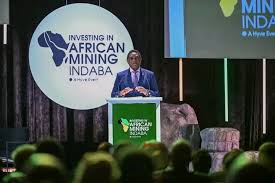
Minister Mantashe calls for continental unity as Mining Indaba opens amid global resource tensions.
South Africa’s Minister of Mineral and Petroleum Resources, Gwede Mantashe, opened the 2026 Investing in African Mining Indaba with a call for African nations to act collectively in defending their mineral sovereignty, warning that intensifying geopolitical competition over natural resources poses a growing threat to resource-rich developing economies.
Addressing delegates in Cape Town, Mantashe framed the 2026 Indaba theme “Stronger Together: Progress Through Partnerships” as more than symbolic, describing it as a strategic necessity for Africa.
According to the minister, heightened global demand for critical minerals is driving renewed competition among developed economies seeking control over supply chains. Without continental co-ordination, he warned that African countries risk being forced into a “race to the bottom” in negotiations with global investors.
The message aligns with outcomes from the second African Ministers’ Critical Minerals Roundtable, convened in partnership with the African Union, where governments and industry stakeholders agreed that Africa must move beyond extraction toward industrialisation and value addition closer to production.
Regulatory reform and exploration push
Mantashe confirmed that South Africa has completed its long-awaited Critical Minerals Strategy, developed alongside a comprehensive study into the state of the mining sector. Implementation of the strategy is now underway and is expected to inform regulatory reforms aimed at creating a more predictable and transparent investment environment.
A key announcement was the removal of Black Economic Empowerment (BEE) requirements at the prospecting stage. The minister emphasised that the decision is not a retreat from transformation policy but a pragmatic intervention to stimulate high-risk exploration activity.
“Prospecting is a phase where no economic value has yet been proven,” he said, arguing that easing entry barriers is necessary to expand South Africa’s exploration pipeline and increase its share of global exploration investment.
Early signs suggest renewed momentum. Geological surveys have identified significant untapped mineral potential, while projects supported by the Junior Mining Exploration Fund (JMEF) are advancing into active drilling programmes. One notable example is a rare earth exploration project in the Bothaville district of the Free State.
The second round of JMEF funding has already attracted 80 applications targeting commodities, including tin, tungsten, titanium, uranium, gold, copper and lithium.
Complementing the exploration drive is the launch of the Council for Geoscience’s Virtual Core Library, a digital platform designed to modernise access to geological data and improve investor transparency.
Investment signals and licensing activity
Despite ongoing regulatory reviews, the department reports continued investment activity. Several new operations have entered production, including West Wits Mining’s Qala Shallows gold project, the Ivanplats Platreef mine, and multiple new coal operations.
Between February 2025 and January 2026, the department granted 358 prospecting rights and 32 mining rights, a figure the minister cited as evidence of sustained investor confidence.
Government, he said, remains committed to strengthening licensing efficiency while protecting national interests.
Safety milestone
Mantashe concluded by acknowledging safety improvements across the sector. South Africa recorded 41 mining fatalities in 2025, the lowest on record surpassing the previous benchmark of 42 in 2024. While reiterating that one fatality is too many, he described the progress as evidence that the industry’s zero-harm objective is achievable through collaboration.
Related Articles
Endeavour announces transaction in own shares...
10 Sep, 2024 07:27
Ivanhoe Mines Announces MOU with Government of Zam...
10 Sep, 2024 12:24
Feasibility Study on Lumwana Super Pit Expansion E...
12 Sep, 2024 14:21
Endeavour achieves commercial production at BIOX e...
13 Sep, 2024 08:20
Roscan Gold Announces Changes to the Board of Dire...
16 Sep, 2024 10:40
Minerals Council pays tribute to Pravin Gordhan...
16 Sep, 2024 12:17
Notification of an acquisition of beneficial inter...
18 Sep, 2024 08:39
Newmont on track to get at least $2 billion from a...
18 Sep, 2024 10:49
UAE firm plans to invest $500m in Tanzania...
19 Sep, 2024 08:37