Mining Other

DRC and Rwanda formalize mineral export oversight with the United States in Strategic Security Pact


By: Africa sustainability matters
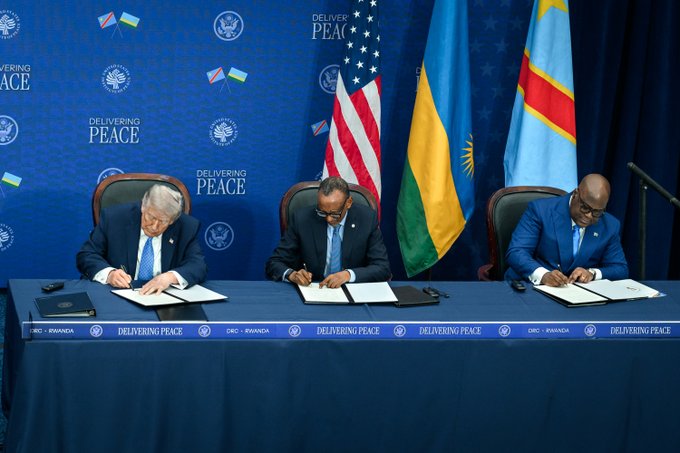
The United States, the Democratic Republic of the Congo, and Rwanda have signed a landmark framework integrating mineral governance, regional security, and industrial investment, marking a major shift in the management of Central Africa’s critical resources. The agreement establishes a system in which companies seeking access to minerals must engage directly with the governments in Kinshasa and Kigali, with governance reforms and security cooperation tied to U.S. investment and support.
Central to the framework is the formalization of mineral supply chains in eastern DRC, a region long dominated by informal, illicit networks and armed groups. By requiring legal and traceable sourcing, the deal aims to strengthen state authority, cut off funding to militias, and secure reliable supplies of cobalt, copper, and tungsten for global markets. The U.S. will support security sector reforms and infrastructure projects like the Lobito Corridor, a key export route designed to bypass intermediaries and strengthen regional integration.
The framework also serves as a strategic counter to China’s dominant presence in the DRC’s mineral sector by emphasizing transparency, traceability, and adherence to higher governance standards. For Rwanda, the deal links its own regulated tungsten sector to regional security and border management cooperation. The approach could impact other global players, such as Saudi Arabia and the EU, while offering an alternative model for mineral governance in Africa.
However, its success hinges on resolving persistent security challenges in eastern DRC, enforcing governance reforms, and ensuring that local communities benefit from industrial investment. If implemented effectively, the framework could become a blueprint for sustainable resource management that balances economic development, state sovereignty, and regional stability
Related Articles
Endeavour announces transaction in own shares...
10 Sep, 2024 07:27
Ivanhoe Mines Announces MOU with Government of Zam...
10 Sep, 2024 12:24
Feasibility Study on Lumwana Super Pit Expansion E...
12 Sep, 2024 14:21
Endeavour achieves commercial production at BIOX e...
13 Sep, 2024 08:20
Roscan Gold Announces Changes to the Board of Dire...
16 Sep, 2024 10:40
Minerals Council pays tribute to Pravin Gordhan...
16 Sep, 2024 12:17
Notification of an acquisition of beneficial inter...
18 Sep, 2024 08:39
Newmont on track to get at least $2 billion from a...
18 Sep, 2024 10:49
UAE firm plans to invest $500m in Tanzania...
19 Sep, 2024 08:37